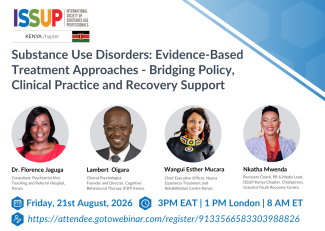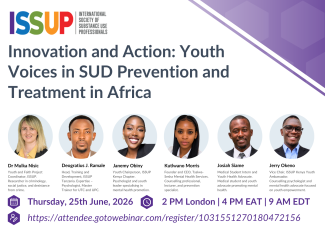
ISSUP Kenya would like to invite you to its webinar onSubstance Use Disorders: Evidence-Based Treatment Approaches; Bridging Policy, Clinical Practice and Recovery Support.
Buja, A., Montecchio, L. & Dossi, F. Association Between Religiosity and Spirituality and Cocaine Use: A Systematic Review. J Relig Health 63, 3532–3579 (2024). https://doi.org/10.1007/s10943-024-02069-6
This systematic review examines the association between religiosity, spirituality, and cocaine use by analysing findings from 20 observational studies involving adults and adolescents. Most studies found that higher levels of religiosity were associated with lower lifetime and current cocaine use, suggesting that religious engagement may serve as a protective factor against substance use.
The review also highlights important exceptions. One study involving sexual minority participants found that certain forms of private religious practice were associated with higher cocaine use, while several...
This article explores how faith-based recovery programs combine spiritual support with evidence-based addictiontreatment to help people achieve and maintain recovery. These programs integrate religious beliefs and practices with services such as detoxification, counselling, behavioural therapies, rehabilitation, and aftercare.
Faith-based approaches may provide additional benefits through shared values, community support, accountability, and opportunities to address feelings of shame and stigma often associated with substance use disorders. The article also highlights a range of faith...
Koh HK, Frederick DE, Balboni TA, O'Reilly SM, Kelly JF, Humphreys K, Botticelli M, Mathur MB, Psimopoulos CS, Long KNG, VanderWeele TJ. Spirituality and Harmful or Hazardous Alcohol and Other Drug Use: A Meta-Analysis of Longitudinal Studies. JAMA Psychiatry. 2026 Apr 1;83(4):363-378. doi: 10.1001/jamapsychiatry.2025.4816. PMID: 41706493; PMCID: PMC12917744.
This meta-analysis reviewed 55 longitudinal studies involving more than 540,000 participants to examine the relationship between spirituality and harmful or hazardous alcohol and other drug use. The findings show that spiritual and religious involvement is associated with a 13% reduction in the risk of substance use and related harms, with even stronger protective effects among individuals who regularly participate in religious communities.
The protective association was observed across alcohol, tobacco, cannabis, and other illicit drugs, and was linked to both prevention of substance use and...
This European guide by EUDA highlights the importance of addressing dual disorders, where mental health conditions and substance use disorders occur at the same time. These co-occurring conditions are common and often lead to poorer health outcomes, increased social marginalisation, and more complex recovery pathways.
The guide emphasizes that effective responses require integrated and coordinated care, bringing together mental health services, addictiontreatment, medication management, and social support. It also highlights the value of early identification, personalised treatment plans...
Yeung JWK. Faith-based intervention, change of religiosity, and abstinence of substance addicts. Braz J Psychiatry. 2022 Jan-Feb;44(1):46-56. doi: 10.1590/1516-4446-2020-1576. PMID: 34190824; PMCID: PMC8827378.
This study examines how changes in religiosity influence recovery outcomes among people in addictiontreatment. It finds that individuals in faith-based programs show higher and increasing levels of religiosity over time, which is linked to better abstinence outcomes after treatment.
While both faith-based and secular programs provide similar clinical support (e.g. counseling, social support), faith-based approaches add a strong spiritual dimension, which appears to strengthen long-term recovery. The findings highlight that religiosity is not static—its development over time plays an...
ISSUP Nigeria presents the 30th session of its bi-monthly webinar in the Knowledge Update Series. This webinar will focus on the topic 'Integrated Behavioural Health Approaches In Substance Use Disorder (SUD) Prevention, Treatment And Recovery: Bridging Gaps In Service Delivery'.
ISSUP Nigeria would like to invite you to the 30th session of its bi-monthly webinar in the Knowledge Update Series. This webinar will focus on the topic 'Integrated Behavioural Health Approaches In Substance Use Disorder (SUD) Prevention, Treatment And Recovery: Bridging Gaps In Service Delivery'.
Admase et al. Substance AbuseTreatment, Prevention, and Policy (2025) 20:43 https://doi.org/10.1186/s13011-025-00660-y
Background
Stigma related to drug use is a well-documented barrier to engaging and remaining on medication for opioid use disorder (MOUD), yet little is known about how stigma operates across multiple social and institutional settings in low-resource contexts.
Methods
This qualitative study draws on 40 in-depth interviews with current and former MOUD clients and four focus groups with 35 current clients at an opioid treatment clinic in Dar es Salaam, Tanzania. Transcripts were thematically analyzed to explore how stigma influenced MOUD adherence and retention.
Zijp et al. Substance AbuseTreatment, Prevention, and Policy (2025) 20:44 https://doi.org/10.1186/s13011-025-00672-8
Background
Smoking is more common in lower socioeconomic position (SEP) groups, but smoking cessation interventions are less effective for these groups. StopCoach, an mHealth intervention, supports people with lower SEP in quitting smoking. A non-randomized controlled trial found that adding StopCoach to accredited smoking cessation counselling (SCC) led to higher abstinence rates immediately after and one year after SCC, compared to SCC alone. Users also rated its usability, acceptability, and practicality positively. Recent studies show a dose-response relationship, where more mHealth use...
We recently (15-19 September 2025) had the pleasure of attending the ISSUP Indonesia 2025 Regional Event , a dynamic gathering that convened policymakers, practitioners, academics, and civil society actors from across the globe. In this report, I reflect on the themes and discussions that resonated throughout the conference, with particular attention to the plenary sessions I had the privilege of moderating: Plenaries 3, 5, and 11.
The conference as a whole was marked by excellent participation, lively discussion, and an energetic exchange of ideas. Attendees were able to engage across a...
The 2025 Annual Report to the Parliament on Drug Addictions in Italy offers a comprehensive overview of the current drug addiction landscape. Despite a slight decline in youth drug use for the first time since 2018, the report highlights ongoing challenges, particularly with substances like cocaine, synthetic opioids, and high-potency cannabis derivatives. Law enforcement and judicial efforts remain strong, and Italy continues to be a key collaborator in global anti-drug initiatives, particularly with countries in South America and the Indo-Pacific region.
This resource is designed to help leaders and managers transfer current technology on ‘what works’ and what is efficient and ethical management in drug treatment into practice.