
The activities of authorised agencies such as police, customs, border services, and investigative bodies to enforce drug control laws and address criminal activities related to the production, trafficking, and distribution of illicit substances. These activities may include investigations, intelligence gathering, interdiction, and collaboration with national and international partners to disrupt organised crime networks. Law enforcement plays an important role in protecting public safety and maintaining the rule of law, and is most effective when coordinated with broader public health, prevention, treatment, and recovery efforts as part of a balanced and comprehensive response to substance use.

Law Enforcement
Faith-Based Interventions for Reducing Gang Violence in the Caribbean: Reflections from a Professor and a Priest
This book chapter explores the role of faith-based interventions in preventing and reducing gang violence in Trinidad and Tobago. Drawing on the experiences of a criminologist and a religious leader, it argues that gang violence should be...
Religiosity and crime: Evidence from a city-wide shock
This study examines the relationship between religiosity and crime using data from the 2015 visit of Pope Francis to Philadelphia. By analysing daily crime reports before, during, and after the visit, the researchers found a significant...
Exploring Community Responses to the Substance Use Crisis
Attendance
online
July 23, 2026, 1-2 pm ET
Law Enforcement and Prevention of Problem Behaviors: An Important Connection to Improve the Health and Safety of Our Communities
Why is the connection between law enforcement and prevention of problem behaviors such as substance use important? Perhaps it is Safety within our communities. While law enforcement is responsible for enforcing laws and maintaining public...
Drug production and precursors — EUDA ongoing activities
The European Union Drugs Agency (EUDA) continues to monitor illicit drug production and precursor chemicals across Europe to improve understanding of how drug markets are evolving. Production within the European Union is primarily focused...
The Role of Law Enforcement in the Reduction of Substance Use and Other Behavioral Health Risks: Substance Use as a Focus: United States as an Example
This paper explores how law enforcement can contribute to the prevention of substance use and other behavioural health risks beyond their traditional enforcement role. Using the United States as an example, it argues that police and other...
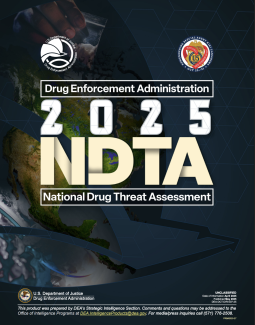
2025 National Drug Threat Assessment (NDTA) - Drug Enforcement Administration (DEA)
The U.S. Drug Enforcement Administration (DEA) has released its 2025 National Drug Threat Assessment (NDTA), providing an overview of the threats posed by illicit drugs and the transnational criminal organizations involved in their production and trafficking. The report highlights the continuing impact of synthetic drugs, particularly fentanyl and methamphetamine, on public health, public safety, and national security.
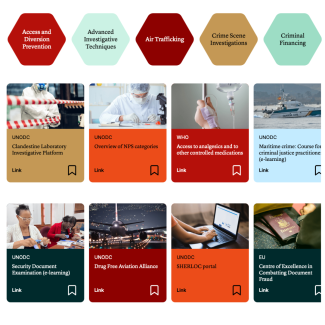
UN Toolkit on Synthetic Drugs
The UN Toolkit on Synthetic Drugs is a practical online resource coordinated by UNODC that brings together tools, guidance, and operational resources from across the UN system to support responses to the global synthetic drug problem...
New UNODC Toolkit Module on Security Document Examination: Launching event
Attendance
online
UNODC has launched a new Security Document Examination module within the UN Toolkit on Synthetic Drugs to help law enforcement, border control, and forensic professionals detect and respond to document fraud linked to synthetic drug trafficking.
NEW Security Document Examination module in the UN Toolkit on Synthetic Drugs
UNODC has launched a new Security Document Examination module within the UN Toolkit on Synthetic Drugs, developed in collaboration with the UNODC Laboratory and Scientific Services. The module aims to help law enforcement, border control...