Programmes within correctional or community settings focusing on treatment and re-entry support following release to facilitate reintegration e.g., counselling and employment services.
Rehabilitation and Re-Entry Services
This study examines how religious support during and after incarceration influences substance use and recidivism among people returning to the community. Using data from the Serious and Violent Offender Reentry Initiative, the authors...

Youth Narratives Concerning Drug Trafficking in Sinaloa: Joining, Risks, and Plans
This qualitative study explores the experiences of young people involved in drug trafficking in Culiacán, Sinaloa, Mexico. Based on interviews with 16 young adults, the research examines why they joined drug trafficking, how they perceived...
Child Criminal Exploitation and the Interactional Emergence of Victim Status
This article draws on observations and interviews with youth justice practitioners and young people involved in county lines drug dealing to explore the processes by which young people are identified as victims of child criminal...
A Whole Person Approach: Adding Addiction Medicine Services to a Drug Treatment Court Program
Attendance
online
This session explores how a successful partnership was formed between addiction medicine providers and a drug treatment court. Presenters will explain how the collaboration began, how it is funded, and how it has been maintained.
A Reading List on Responding to Drug-Related Offending through Science-Based Policy and Practice
As justice systems increasingly shift their focus from punishment to rehabilitation, it becomes essential to understand the complex relationship between substance use, criminal behaviour, and treatment, particularly among individuals whose involvement with the system stems from substance use.
Care without conditions — housing-first and employment-first approaches
Attendance
online
Background: Across Europe, people who use drugs face persistent barriers to housing, decent work, healthcare and safety. All too often, ‘reintegration’ tends to be tied largely to abstinence, at the risk of excluding those who are not ready, or do not wish, to stop using psychoactive substances.
The Addiction Counselor’s Role in Medication-Assisted Treatment and Recovery (MATR) Settings
Attendance
online
Time: 3PM - 4:30PM Eastern Time
ASSOCIATION BETWEEN THE IMPLEMENTATION OF SNI 8807:2022 AND THE REHABILITATION CAPABILITY INDEX IN NATIONAL PRIORITY PROGRAMS
Background: In 2023, the prevalence of drug abuse in Indonesia among the population aged 15–64 years reached 1.73%, equivalent to 3.33 million people. This problem has prompted The National Narcotics Board (BNN) as a government agency which...
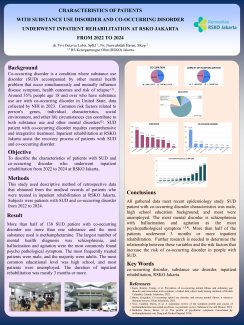
Characteristics of Patients with Substance Use Disorder and Co-occuring Disorder Underwent Inpatient Rehabilitation at RSKO Jakarta from 2022 to 2024
Co-occurring disorder is a condition where substance use disorder accompanied by other mental health problem that occur simultaneously and mutually influence disease symptom, health outcomes and risk of relapse. Around 35% people age 18 and...
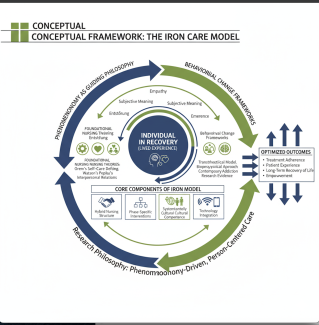
The Integrated Recovery-Oriented Nursing (IRON) Care Model: A Theoretical Framework for Optimizing Addiction Treatment Outcomes
Abstract Title: The Integrated Recovery-Oriented Nursing (IRON) Care Model: A Theoretical Framework for Optimizing Addiction Treatment Outcomes Authors: Ahmad Muneer, MSc, RN; Hessa Abdel Qader, MSc, RN Affiliations: Maudsley Health, Al...