
What Does Cocaine Smell Like? Gasoline, Odor and Risks
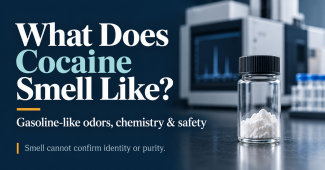
Quick answer: Street cocaine may have little noticeable odor or be described as gasoline-like, solvent-like or faintly sweet. Forensic research identifies methyl benzoate as an important cocaine-associated odor compound and documents residual processing solvents. Neither smell, tongue numbness nor an oily texture can confirm that a substance is cocaine, establish purity or rule out fentanyl.
Emergency warning: Call 911 for chest pain, seizures, severe overheating, difficulty breathing or unresponsiveness after suspected drug use. Give naloxone if opioid exposure is possible and it is available. Naloxone can reverse opioid effects, including fentanyl overdose, but does not reverse cocaine toxicity itself. Follow the emergency dispatcher's instructions.
Key Takeaways
- A gasoline-like smell is a description, not proof that a powder contains cocaine or gasoline.
- Researchers have identified methyl benzoate as an important odor cue for trained cocaine-detection dogs.
- Laboratory detection of an odor compound does not mean a person can notice it in every sample.
- Residual solvents, other ingredients and storage conditions can affect a sample's odor.
- Cocaine and certain adulterants can cause numbness; this does not establish identity or purity.
- An oily, greasy or sticky texture is not a reliable test for cocaine.
- Fentanyl contamination cannot be recognized by looking at, smelling or tasting a substance.
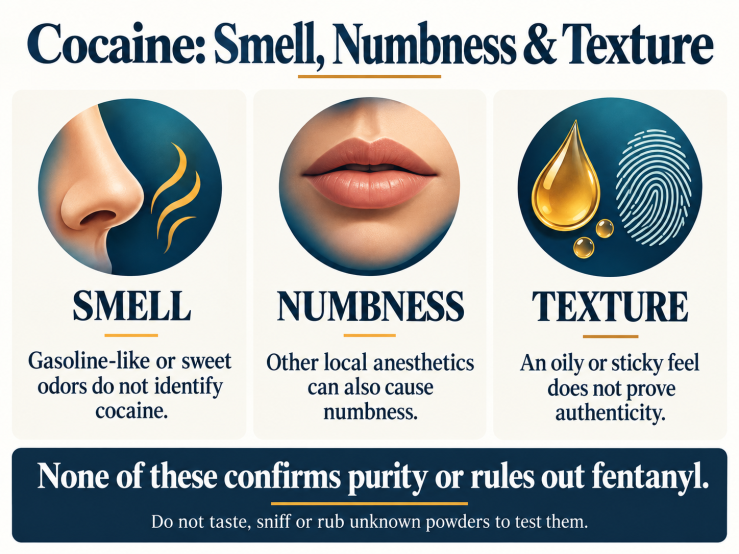
Smell, numbness and texture cannot confirm cocaine identity, purity or the absence of fentanyl.
On This Page
- Cocaine smell at a glance
- Is cocaine odorless?
- What is methyl benzoate?
- Why might cocaine smell like gasoline?
- Do cutting agents change its smell?
- What does crack smoke smell like?
- What does cocaine taste like, and does it numb the tongue?
- Does an oily texture mean cocaine is real?
- Myths versus evidence
- Can you smell fentanyl in cocaine?
- Can cocaine affect the sense of smell?
- How should families respond to suspected cocaine use?
- When should someone seek help?
- Frequently asked questions
- Related ISSUP guides
- References
Cocaine Smell at a Glance
Descriptions of cocaine's smell vary. Different substances can produce similar odors, and samples containing the same drug can smell different. The following table explains those limitations rather than providing a method for identifying an unknown substance.
| Substance or situation | Odor description | What can be concluded? |
|---|---|---|
| Powder sold as cocaine | Little noticeable odor, or reports of a chemical, solvent-like or faintly sweet smell | No consistent human smell identifies cocaine or establishes purity. |
| A powder with a gasoline-like smell | Fuel-like or solvent-like | Residual chemicals are one possible explanation; smell cannot identify the chemicals present. |
| Unheated material sold as crack | Variable; it may have little noticeable odor | Smell does not establish whether it contains cocaine. |
| Smoke associated with crack use | Sometimes described as acrid or resembling burning plastic or rubber | These descriptions are subjective and overlap with other smoke sources. |
| Cocaine contaminated with fentanyl | No dependable distinguishing smell | Fentanyl cannot be ruled in or out through the senses. |
Is Cocaine Odorless?
Cocaine has low volatility, meaning relatively little of the parent drug enters the air under ordinary conditions. However, a sample containing cocaine can release other, more volatile chemicals. Calling every sample “odorless” is therefore too broad, but saying every sample has a noticeable smell also goes beyond the evidence.
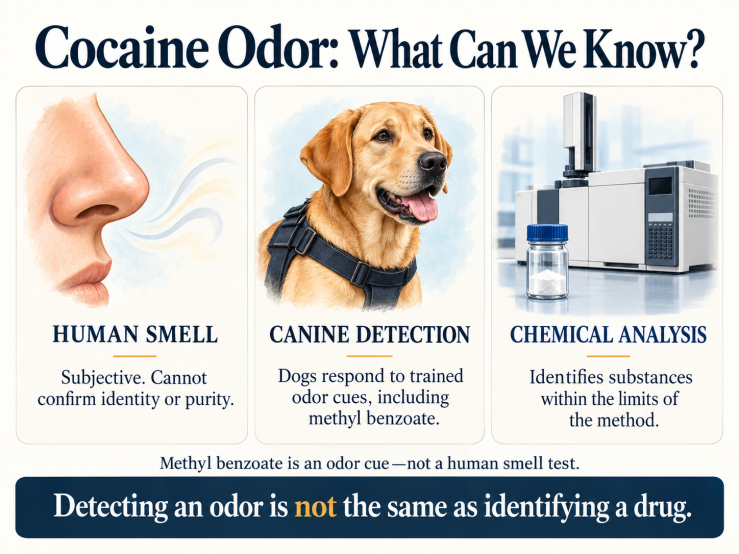
The important distinction is between detecting a chemical with laboratory equipment, detecting an odor with a trained dog and noticing a smell with a human nose. These are different observations and should not be treated as interchangeable.
Research on cocaine odor signatures and detector-dog responses identified methyl benzoate as a dominant odor cue under the study conditions. It did not establish a reliable household smell test.
What Is Methyl Benzoate, and Why Is It Associated With Cocaine?
Methyl benzoate is a volatile compound associated with cocaine odor research. It also occurs in floral fragrances, so its presence is not unique to illicit drugs.
Researchers studying cocaine detection have examined the chemicals released into the air around samples. This airborne chemical mixture is different from the cocaine molecule alone and can help explain why a sample may have an odor even though the parent drug has low volatility.
Why Is Cocaine Sometimes Described as Sweet or Floral?
Methyl benzoate provides a possible explanation for some sweet or floral descriptions. However, identifying it in a sample does not prove that a person will notice a floral smell.
In a study involving snapdragon flowers and cocaine samples, certified detection dogs distinguished the samples despite both odor profiles containing methyl benzoate. The findings illustrate why the broader chemical mixture matters. See the study of methyl benzoate, snapdragon flowers and canine detection.
Clinical perspective: An odor-associated chemical is not the same as a confirmed drug identification. A familiar smell should never be used to reassure someone about an unknown powder.
Why Might Cocaine Smell Like Gasoline or Other Chemicals?
A gasoline-like or solvent-like smell may reflect residual chemicals associated with illicit processing. However, describing an odor as “gasoline-like” does not demonstrate that gasoline is present.
Forensic researchers have measured residual solvents in seized cocaine, including compounds such as acetone, toluene and ethyl acetate. Some solvents remain trapped within the crystal structure; forensic literature calls these occluded solvents. Analysts use chemical instruments to measure them and compare samples.
A study of chemical markers in seized cocaine examined residual solvents alongside other impurities. Separate research on processing solvents and cocaine hydrochloride demonstrated that the solvent profile retained in the final material can differ from the original processing mixture.
Does a Stronger Gasoline Smell Mean Higher Purity?
No. Odor intensity is not a measure of cocaine concentration. A strong chemical smell does not establish that a product is stronger, more authentic or less adulterated.
The research supports residual solvents as a possible explanation for chemical odors. It does not support claims that all cocaine smells like gasoline or that a person can identify a particular solvent by smelling the material.
Do Cutting Agents Change the Smell of Cocaine?
Added substances can change a sample's overall characteristics, but smell cannot reliably reveal which cutting agents are present. A sample with little odor can still contain medically significant adulterants.
Laboratory studies have identified substances including levamisole, benzocaine, phenacetin and caffeine in seized cocaine. Their presence and concentrations vary. See this study measuring cutting agents in seized cocaine samples.
Avoid assuming that every harsh smell comes from a cutting agent, or that cutting agents never influence odor. Identifying the ingredients requires chemical testing rather than a sensory description.
Appearance is equally unreliable. The related guide What Is Fishscale Cocaine? Purity, Adulterants and Risk discusses why a shiny or flaky appearance should not be treated as evidence of safety.
What Does Crack Cocaine Smoke Smell Like?
Crack smoke is sometimes described as acrid, chemical or similar to burning plastic or rubber. These are subjective descriptions, not a validated way to identify the drug.
Heating cocaine produces a mixture that differs from unheated powder. Experimental research has identified breakdown products including anhydroecgonine methyl ester and benzoic acid. However, detecting those compounds does not establish which one causes a particular smell reported by people. See the experimental study of cocaine's thermal decomposition.
Does Unheated Crack Smell the Same as Crack Smoke?
Not necessarily. Heating changes the substances released into the air, so the odor of an unheated material should not be assumed to match its smoke. Neither odor provides a reliable identification test.
If you notice an unexplained chemical or burning smell, do not deliberately inhale more smoke to investigate. Other substances, burning materials and environmental hazards can produce similar odors.
What Does Cocaine Taste Like, and Does It Numb the Tongue?
Cocaine is often described as bitter and can numb tissue because it is a local anesthetic. However, bitterness and numbness are not unique to cocaine. Neither sensation can establish the identity or purity of an unknown powder.
Local anesthetics such as lidocaine and benzocaine may be added to illicit cocaine and can imitate its numbing effect. Research on local anesthetics used as cocaine adulterants explains why this sensation can mislead people about a product's contents.
Does Immediate Numbness Prove It Is Cocaine?
No. Even rapid numbness cannot confirm that a powder contains cocaine. The onset or intensity of a numbing effect cannot determine how much cocaine is present or whether other drugs have been added.
Do not taste an unknown powder or put it on your gums to identify it. Testing it this way creates an exposure without providing a dependable answer.
Does an Oily Texture Mean Cocaine Is Real?
No. Rubbing a powder between your fingers and finding that it becomes oily, greasy or sticky is not a validated identification test.
How a powder feels can be influenced by moisture, other ingredients and oils already on the skin. Texture cannot establish the presence of cocaine, measure its concentration or rule out fentanyl and other contaminants.
The same limitation applies to judging a substance by its shine or crystal-like appearance. See What Is Fishscale Cocaine? Purity, Adulterants and Risk for related appearance and purity misconceptions.
Cocaine Smell, Taste and Texture: Myths Versus Evidence
| Claim | What the evidence supports |
|---|---|
| “Real cocaine always smells like gasoline.” | Odor varies. A gasoline-like smell cannot identify cocaine. |
| “A stronger chemical smell means stronger cocaine.” | Odor intensity does not measure cocaine concentration. |
| “No smell means it is pure.” | Little noticeable odor does not establish purity or safety. |
| “It numbs my tongue, so it must be cocaine.” | Other local anesthetics can cause numbness. |
| “It becomes oily between my fingers, so it is real.” | Texture is not a validated identification method. |
| “A harsh smell means fentanyl was added.” | Fentanyl contamination has no dependable sensory warning. |
| “Detection dogs smell cocaine, so people can identify it too.” | Canine detection research does not validate human smell testing. |
Can You Smell Fentanyl in Cocaine?
No. You cannot reliably see, smell or taste fentanyl mixed into another drug. A familiar odor does not establish that the supply is unchanged or safe. The CDC's fentanyl guidance explains this limitation.
Fentanyl test strips can help detect fentanyl, but a negative result does not guarantee safety. They do not establish cocaine purity or identify every possible contaminant. Follow the test manufacturer's instructions and seek guidance from a local harm-reduction service about available drug-checking options.
What If Someone Becomes Unresponsive After Using Cocaine?
Very slow breathing, unusual unresponsiveness or an inability to wake someone after supposed cocaine use can indicate opioid exposure or another emergency. Call 911 and give naloxone if available. Follow the dispatcher's instructions for rescue breathing or CPR, and stay with the person until help arrives.
CDC guidance on naloxone explains its role in reversing opioid overdose. Cocaine can also cause a life-threatening emergency without fentanyl; see Cocaine Overdose: Signs, Symptoms, and What to Do.
Can Cocaine Affect Your Sense of Smell?
Repeated snorting can damage nasal tissue and impair the sense of smell. However, cocaine's local numbing effect should not be used as a blanket explanation that everyone who uses it becomes unable to smell it.
MedlinePlus information on cocaine identifies loss of smell, nosebleeds and nasal damage among the risks of snorting. Persistent symptoms warrant medical assessment.
A foul odor coming from the nose is different from the odor of a powder. It may accompany a nasal problem that needs evaluation. Read Coke Nose: How Cocaine Damages the Nose and When It Becomes Irreversible.
How Should Families Respond to Suspected Cocaine Use?
Focus on observable concerns about health, behavior and daily functioning rather than trying to prove cocaine use through smell, taste or texture. An unfamiliar powder or odor can raise questions, but it does not establish what a substance contains or whether someone has used it.
For additional family-focused information, see Intervention New York's guide to recognizing cocaine. Treat sensory observations as reasons to seek reliable information, not as confirmation of drug identity or purity.
- Choose a calm time to discuss your concerns when there is no immediate emergency.
- Describe specific observations without claiming that an odor proves drug use.
- Avoid tasting, directly sniffing or rubbing an unknown substance to investigate it.
- Keep unknown substances away from children and pets.
- Encourage a professional assessment when substance use may be affecting health, relationships or responsibilities.
For families concerned about repeated use or difficulty stopping, Is Cocaine the Hardest Drug to Quit? Withdrawal & Recovery provides a related discussion of recovery.
When Should Someone Seek Help?
Seek emergency help for chest pain, seizures, severe overheating, breathing problems or loss of consciousness after suspected cocaine use. Do not wait to identify the substance by its smell. The guide Cocaine Overdose: Signs, Symptoms, and What to Do provides additional context.
For ongoing concerns, repeated sleep disruption, cravings, difficulty cutting down or continued use despite harm are reasons to seek an assessment. None of these observations alone identifies a particular substance.
Evidence-based treatment can help. NIDA describes behavioral approaches, including contingency management and cognitive behavioral therapy, in its cocaine research report. Treatment should address the person's medical needs, mental health and circumstances.
Persistent nasal pain, recurring nosebleeds or changes in smell also deserve medical attention. See Coke Nose: How Cocaine Damages the Nose and When It Becomes Irreversible for more information about nasal complications.
Frequently Asked Questions
Does cocaine always have a strong smell?
No. A sample may have little noticeable odor or a more apparent chemical smell. Human perception varies, and odor does not provide a dependable measure of identity, concentration or contamination. An odorless-seeming powder should not be considered safer.
Does a gasoline smell mean cocaine is stronger?
No. A gasoline-like smell is not a measure of cocaine concentration. Residual chemicals may contribute to an odor, but neither their identity nor the amount of cocaine can be established by smelling the material. Strong odor should not be interpreted as a sign of quality.
Why is cocaine sometimes described as smelling like flowers?
Methyl benzoate, an odor compound associated with cocaine research, also occurs in floral fragrances. This provides a possible chemical explanation for some sweet or floral descriptions. It does not mean every cocaine sample smells floral or that a floral-smelling powder contains cocaine.
Can you identify cocaine on someone's breath or clothes?
No dependable smell test identifies cocaine use from breath or clothing. Smoke, fragrances, cleaning products and other environmental sources can overlap. An unfamiliar odor may prompt a conversation, but it is not proof that someone used cocaine.
Does numbness prove a substance contains cocaine?
No. Cocaine can cause numbness, but local anesthetics used as adulterants can do the same. Numbness cannot identify the substance, establish its purity or rule out additional drugs. Do not taste or apply a powder to your gums to test it.
Is oily cocaine more likely to be real?
An oily or greasy feel does not establish that a substance contains cocaine. Moisture, other ingredients and skin oils can affect texture. Rubbing a powder between your fingers is not a validated test for identity, concentration or contamination.
Does crack always smell like burning plastic?
No. Burning plastic and rubber are descriptions sometimes used for crack smoke, but they are subjective and are not specific to cocaine. Other burning materials can produce similar odors. Do not deliberately inhale smoke to determine its source.
What is more reliable than smell or texture?
Appropriate chemical analysis is more reliable. Drug-checking services differ in what they can detect, and screening tests have limitations. A fentanyl strip addresses a specific contamination concern; it is not a complete analysis or a certificate that a substance is safe.
Related ISSUP Guides
- Cocaine Overdose: Signs, Symptoms, and What to Do
- Coke Nose: How Cocaine Damages the Nose and When It Becomes Irreversible
- What Is Fishscale Cocaine? Purity, Adulterants and Risk
- Is Cocaine the Hardest Drug to Quit? Withdrawal & Recovery
References and Further Reading
- Identification of odor signature chemicals in cocaine using solid-phase microextraction-gas chromatography and detector-dog response.
- Assessment of detection canine alerts using flowers that release methyl benzoate.
- A data-driven methodology to discover similarities between cocaine samples.
- Analysis of South American commercial solvents used in illicit cocaine processing.
- Determination of cutting agents in seized cocaine samples.
- Thermal decomposition of adulterated cocaine samples.
- Health risks of cocaine adulteration: local anesthetics.
- CDC: Fentanyl Facts.
- CDC: Lifesaving Naloxone.
- MedlinePlus: Cocaine.
- NIDA: Cocaine Research Report.
Published: October 19, 2026 | Last updated: October 19, 2026
About the Author
Benjamin Zohar, NCACIP is a Nationally Certified Advanced Clinical Intervention Professional and ISSUP network moderator specializing in addiction intervention, treatment navigation and emerging substance-use risks. His educational work published through ISSUP on counterfeit medications, fentanyl exposure and concentrated 7-hydroxymitragynine has been cited or referenced by GoodRx, The Washington Post, WIRED and Newsweek.
Medically reviewed by: Brandon McNally, RN
Medical disclaimer: This article is intended for educational and public-health purposes. It does not provide individualized medical advice, diagnosis or a tapering schedule. Do not start, stop or alter a prescription medication without consulting a qualified healthcare professional. Call emergency services for seizures, difficulty breathing, loss of consciousness, severe confusion or other life-threatening symptoms.