
Brixadi Injection: Dosing Chart, Side Effects, Doses & Sublocade Comparison
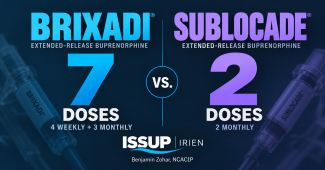
Quick answer: Brixadi (buprenorphine extended-release injection) is an FDA-approved treatment for moderate to severe opioid use disorder. It is available in seven strengths: Brixadi Weekly 8 mg, 16 mg, 24 mg, and 32 mg, and Brixadi Monthly 64 mg, 96 mg, and 128 mg. Weekly doses are given at 7-day intervals and monthly doses at 28-day intervals. Brixadi is administered subcutaneously by a healthcare professional and is available only through the restricted Brixadi REMS distribution program.
Last updated: September 19, 2026. This article summarizes current U.S. FDA prescribing information and should be read as education, not individualized dosing advice.
Safety note: Buprenorphine started too soon after fentanyl, heroin, or methadone can trigger precipitated withdrawal. If someone has severe breathing difficulty, is unresponsive, or is having a seizure, call 911. For confidential treatment referrals, the SAMHSA National Helpline is 1-800-662-4357.
Key Takeaways
- Brixadi (buprenorphine extended-release injection, CIII) was approved by the FDA in May 2023 and is manufactured by Braeburn.
- Two formulations exist: Brixadi Weekly (8, 16, 24, 32 mg every 7 days) and Brixadi Monthly (64, 96, 128 mg every 28 days). Weekly doses cannot be combined to make a monthly dose.
- Brixadi contains buprenorphine only. It does not contain naloxone; Suboxone does.
- Injection sites are the buttock, thigh, abdomen, or upper arm. Weekly injections must be rotated; monthly injections do not require rotation.
- Brixadi is stored at room temperature. Sublocade must be refrigerated.
- Only patients already tolerating buprenorphine (or who pass a 4 mg transmucosal test dose) can receive Brixadi; Brixadi Monthly is not for new entrants to treatment.
- After steady state, buprenorphine from Brixadi remains detectable in blood for about 1 month (weekly) or about 4 months (monthly) after the last injection.
- Both Brixadi and Sublocade carry an FDA boxed warning for intravenous self-injection and are distributed only through a REMS program.
Table of Contents
- What Is Brixadi?
- Brixadi Doses
- Brixadi Dosing Chart
- Weekly vs. Monthly
- Injection Sites
- Why a Pharmacy Can't Fill It
- Side Effects
- Brixadi vs. Sublocade
- Brixadi vs. Suboxone
- How Long It Stays in Your System
- Brixadi Withdrawal
- What Patients Report
- Myth vs. Fact
- Cost and Access
- When to Seek Help
- Common Brixadi Questions
- FAQ
What Is Brixadi? Extended-Release Buprenorphine for Opioid Use Disorder
Brixadi is a long-acting form of buprenorphine, a partial opioid agonist, delivered as a subcutaneous depot injection that releases medication steadily for one week or one month. It is FDA-approved for moderate to severe opioid use disorder (OUD) in adults who have already tolerated a transmucosal buprenorphine dose or are already being treated with buprenorphine.
Buprenorphine works differently from full agonists like heroin, fentanyl, or methadone. It binds tightly to the mu-opioid receptor but only partially activates it, which relieves withdrawal and cravings while producing a ceiling on respiratory depression. Because it occupies the receptor so firmly, it also blunts the effect of other opioids taken on top of it. In Brixadi's opioid-blockade study, weekly injections of 24 mg or 32 mg blocked the drug-liking effect of intramuscular hydromorphone at both 6 mg and 18 mg doses.
Once injected, Brixadi's liquid formulation turns into a liquid crystalline gel on contact with body fluid. That gel is the depot. It biodegrades over the dosing interval and cannot be removed once placed.
Does Brixadi block opiates?
Brixadi can reduce the effects of full opioid agonists because buprenorphine binds strongly to the mu-opioid receptor. In the Brixadi opioid-blockade study, weekly 24 mg and 32 mg doses blocked the drug-liking effects of intramuscular hydromorphone at the tested challenge doses. This does not mean overdose is impossible: attempts to override buprenorphine with large amounts of opioids can be dangerous, and emergency pain treatment requires clinical planning.
Who makes Brixadi and when was it approved?
Brixadi is made by Braeburn. The FDA approved it on May 23, 2023, making it the second long-acting injectable buprenorphine product available in the United States after Sublocade (2017). Outside the U.S. the same formulation is sold as Buvidal, which is why "buvidal" searches often lead to Brixadi information. The prescribing information was most recently revised in December 2025.
Is Brixadi a controlled substance?
Yes. Buprenorphine is a Schedule III controlled substance under the Controlled Substances Act, and Brixadi's label carries the CIII designation. Certified clinics must handle it with the same security and accountability required for any Schedule III product.
Does Brixadi have naloxone in it?
No. Brixadi contains buprenorphine free base and inactive ingredients only. Naloxone is added to sublingual products like Suboxone and Zubsolv to discourage injection misuse; that safeguard is unnecessary in a product that a clinician injects and that forms a gel when it touches blood. Neither Brixadi nor Sublocade contains naloxone.
Brixadi Doses: All Seven FDA-Approved Strengths
Brixadi comes in seven strengths across two formulations. The weekly product is a 50 mg/mL solution and the monthly product is a much more concentrated 356 mg/mL solution, which is why the monthly injection volumes are smaller than the weekly ones despite carrying more buprenorphine. Both are supplied in a prefilled safety syringe with a 23-gauge, half-inch needle.
| Formulation | Dose | Injection volume | Concentration | Dosing interval |
|---|---|---|---|---|
| Brixadi Weekly | 8 mg | 0.16 mL | 50 mg/mL | Every 7 days (±2 days) |
| Brixadi Weekly | 16 mg | 0.32 mL | ||
| Brixadi Weekly | 24 mg | 0.48 mL | ||
| Brixadi Weekly | 32 mg | 0.64 mL | ||
| Brixadi Monthly | 64 mg | 0.18 mL | 356 mg/mL | Every 28 days (±1 week) |
| Brixadi Monthly | 96 mg | 0.27 mL | ||
| Brixadi Monthly | 128 mg | 0.36 mL |
The maximum dose is 32 mg per week or 128 mg per month. A supplemental 8 mg weekly injection may be given during a dosing interval, at the clinician's judgment, as long as the total stays within those maximums. A 160 mg monthly dose was used in the Phase 3 trial but is not an approved strength.
Brixadi Dosing Chart: Converting From Suboxone, Subutex, or Zubsolv
The FDA label provides a conversion table for patients switching from daily sublingual buprenorphine directly to Brixadi Weekly or Brixadi Monthly. A patient already stable on a transmucosal product can move to either formulation without a weekly lead-in.
| Daily sublingual buprenorphine dose | Brixadi Weekly | Brixadi Monthly |
|---|---|---|
| 6 mg or less | 8 mg | Not applicable |
| 8 to 10 mg | 16 mg | 64 mg |
| 12 to 16 mg | 24 mg | 96 mg |
| 18 to 24 mg | 32 mg | 128 mg |
The label notes that one Suboxone 8 mg/2 mg tablet, one Subutex 8 mg tablet, and one Zubsolv 5.7 mg/1.4 mg tablet provide equivalent buprenorphine exposure, so the same row applies regardless of which sublingual product the patient was taking.
What Is the Recommended Direct-to-Inject Protocol for Brixadi?
For a patient not currently receiving buprenorphine, the FDA-labeled initiation pathway begins with a 4 mg transmucosal buprenorphine test dose after objective signs of mild-to-moderate withdrawal appear. If that dose is tolerated without precipitated withdrawal, treatment transitions to Brixadi Weekly. Brixadi Monthly is not intended for patients who are not already receiving buprenorphine.
The labeled initiation sequence is:
- Wait until objective signs of mild to moderate opioid withdrawal appear, then give a 4 mg transmucosal buprenorphine test dose.
- If the test dose is tolerated without precipitated withdrawal, give a 16 mg Brixadi Weekly injection.
- Within 3 days, give an additional 8 mg weekly injection to reach the recommended 24 mg weekly dose.
- If needed during that first week, one more 8 mg injection (at least 24 hours after the previous one) brings the weekly total to the 32 mg maximum.
Subsequent weekly injections match the total established in week one. Once a patient is stable on weekly dosing, they can transition to the corresponding monthly dose.
Clinical pearl: The upper-arm site delivers roughly 10% lower plasma buprenorphine than the buttock, thigh, or abdomen. For that reason the label restricts the arm to patients on Brixadi Weekly who have reached steady state (four consecutive doses) and are not new to buprenorphine. A new patient who reports breakthrough cravings after arm injections may need a site change before a dose change.
Brixadi Weekly vs. Brixadi Monthly: Transition Doses and Timing Windows
Patients can move between the two formulations in either direction based on clinical judgment. The label pairs the doses as follows:
| Brixadi Weekly | Brixadi Monthly |
|---|---|
| 16 mg | 64 mg |
| 24 mg | 96 mg |
| 32 mg | 128 mg |
The two formulations are different chemical preparations. Four 16 mg weekly syringes do not equal one 64 mg monthly syringe and must never be combined.
Timing flexibility differs, too. A weekly dose can be given up to 2 days before or after the scheduled day. A monthly dose can be given up to 1 week before or after. If a dose is missed entirely, the next dose is given as soon as practical and the schedule restarts from there.
Can Brixadi Be Given Every 3 Weeks?
The FDA-approved schedules are every 7 days for Brixadi Weekly and every 28 days for Brixadi Monthly; a routine 3-week schedule is not an approved Brixadi dosing interval. The label allows a timing window of up to 2 days before or after a weekly dose and up to 1 week before or after a monthly dose. A patient who misses a dose should receive the next dose as soon as practical under the treating clinician's direction.
| Feature | Brixadi Weekly | Brixadi Monthly |
|---|---|---|
| Doses | 8, 16, 24, 32 mg | 64, 96, 128 mg |
| Interval | Every 7 days | Every 28 days |
| Dosing window | ±2 days | ±1 week |
| New entrants to treatment | Yes, after 4 mg test dose | No |
| Injection-site rotation | Required (same site not reused for 8 weeks) | Not required |
| Time to peak level | About 24 hours | 6 to 10 hours |
| Half-life | 3 to 5 days | 19 to 26 days |
| Steady state reached | 4th dose (about 4 weeks) | 4th dose (about 4 months) |
| Detectable after stopping (from steady state) | About 1 month | About 4 months |
How Should Brixadi Be Administered? Injection Sites and Technique
Brixadi must be prepared and administered by a healthcare provider as a single subcutaneous injection. It is injected slowly into subcutaneous tissue at one of four sites: the buttock, thigh, abdomen, or upper arm. The clinician pinches the skin, inserts the needle at approximately 90 degrees, depresses the plunger until it latches, holds for 2 seconds, and withdraws. The safety guard covers the needle automatically. Patients are told to report excessive swelling, redness, heat, or drainage at the site right away.
Three rules govern site selection:
- Weekly injections rotate. The same site should not be used again for at least 8 weeks.
- Monthly injections do not require rotation.
- Upper arm is restricted for weekly patients who are new to buprenorphine until four consecutive doses have been given, because arm injections produce about 10% lower plasma levels.
Brixadi must never be given intravenously, intramuscularly, or intradermally. Injected into a vein, the gel can cause vessel occlusion, tissue damage, and life-threatening pulmonary emboli. That risk is the reason for the boxed warning and the REMS program.
Why a Pharmacy Can't Fill Brixadi: The Brixadi REMS Program
Brixadi is available only through a restricted distribution program called the Brixadi REMS (Risk Evaluation and Mitigation Strategy). Healthcare settings and pharmacies that order it must be certified, must verify that the product goes directly to a healthcare provider for administration, and may not dispense it to the patient or transfer, loan, or sell it. This is why a patient cannot pick Brixadi up at a retail pharmacy, and why a prescription alone is not enough: the prescriber's clinic or a certified specialty pharmacy that ships to the clinic must be enrolled.
The REMS exists because of the intravenous self-injection hazard, not because of diversion concerns unique to Brixadi. Sublocade operates under an equivalent REMS for the same reason. Certified clinics can be located through www.BRIXADIREMS.com or 1-833-274-9234, and prescribers who are not yet certified can enroll there.
Practically, this shapes who offers Brixadi. Office-based buprenorphine prescribers, opioid treatment programs, hospital addiction consult services, and some residential and intensive outpatient programs administer it. Removal is not recommended: the depot is not always palpable and is not suited to surgical excision, which differs from Sublocade's solid depot.
Brixadi Side Effects and Warnings
The most common Brixadi side effects are injection-site reactions and the same effects seen with any buprenorphine product. In the Phase 3 double-blind trial (213 patients on Brixadi versus 215 on daily sublingual buprenorphine/naloxone), adverse reactions reported in at least 5% of Brixadi patients were:
| Adverse reaction | Brixadi (n=213) | Daily sublingual buprenorphine/naloxone (n=215) |
|---|---|---|
| Injection-site pain | 9.9% | 7.9% (placebo injection) |
| Headache | 7.5% | 7.9% |
| Constipation | 7.5% | 7.4% |
| Nausea | 7.0% | 7.9% |
| Injection-site redness (erythema) | 6.6% | 5.6% |
| Injection-site itching (pruritus) | 6.1% | 6.0% |
| Insomnia | 5.6% | 2.8% |
| Urinary tract infection | 5.2% | 4.7% |
No injection-site reaction in the trial was rated severe, and 4.7% of Brixadi patients discontinued for adverse reactions versus 2.3% on sublingual treatment. Post-marketing reports from the identical product sold outside the U.S. include injection-site abscess, ulceration, and necrosis, more likely when the injection was accidentally intramuscular or intradermal, and withdrawal symptoms from insufficient dosing that typically appeared around two weeks in and resolved with a dose increase.
What Should You Avoid While Taking Brixadi?
Patients should not add sedatives, benzodiazepines, alcohol, gabapentinoids, other opioids, or other central nervous system depressants without discussing them with the prescribing clinician. Combining CNS depressants with buprenorphine can increase sedation and respiratory-depression risk. The FDA label also cautions about clinically important drug interactions, hepatic impairment, and situations where acute pain treatment may require special management.
Can You Drink Alcohol While on Brixadi?
Alcohol can increase the sedating and respiratory-depressant effects of buprenorphine. Patients receiving Brixadi should discuss alcohol use with their healthcare professional, particularly if they also take benzodiazepines, gabapentinoids, sleep medicines, or other sedating drugs.
Does Brixadi Cause Weight Gain?
Weight gain is not listed among the most common adverse reactions in the Brixadi prescribing information. Individual weight changes can occur during treatment for many reasons, including changes in health, nutrition, activity, recovery status, or other medications. Persistent or unexplained weight changes should be discussed with the treating clinician.
Serious warnings shared with all buprenorphine products
- Respiratory depression, especially combined with benzodiazepines, alcohol, gabapentinoids, or other CNS depressants. The label is explicit that benzodiazepine use is not a reason to deny treatment, but it must be managed.
- Precipitated withdrawal if buprenorphine is given while a full agonist is still active. This is why the test dose exists.
- Hepatitis and liver events: liver function tests are recommended at baseline and periodically. Patients with moderate to severe hepatic impairment are not candidates, because a depot cannot be dialed back quickly.
- Delayed withdrawal on discontinuation and the need to monitor for several months after stopping.
- Neonatal opioid withdrawal syndrome with use in pregnancy, weighed against the substantial risks of untreated OUD.
- Latex sensitivity: the needle cap is derived from natural rubber latex.
- Serotonin syndrome with serotonergic drugs, and a 14-day exclusion around MAOIs.
- Naloxone access: the December 2025 label update directs prescribers to strongly consider prescribing an overdose reversal agent every time Brixadi is started or renewed, because relapse remains possible and buprenorphine overdose may need repeated, higher naloxone doses.
Brixadi vs. Sublocade: The Two Long-Acting Buprenorphine Injections Compared
Brixadi and Sublocade are both extended-release buprenorphine depots for OUD, both given subcutaneously by a clinician, both Schedule III, and both restricted by a REMS. The practical differences are dosing flexibility, storage, depot behavior, and how long the medication lingers after the last dose. The milligram numbers are not comparable across products because the formulations release buprenorphine at different rates.
Why Is Brixadi Better Than Sublocade?
Neither medication is universally better. Brixadi offers both weekly and monthly dosing and seven strengths, which may provide more dosing flexibility. Sublocade is monthly only and has a substantially longer terminal half-life. The clinically appropriate option depends on treatment stage, prior buprenorphine exposure, adherence needs, formulary coverage, patient preference, and the prescriber's judgment.
Is Brixadi Stronger Than Sublocade?
The milligram numbers should not be used to decide which product is "stronger." Brixadi and Sublocade use different extended-release formulations with different pharmacokinetic profiles. Their labeled doses are not milligram-for-milligram equivalents.
| Feature | Brixadi | Sublocade |
|---|---|---|
| Manufacturer / FDA approval | Braeburn / May 2023 | Indivior / November 2017 |
| Active ingredient | Buprenorphine (no naloxone) | Buprenorphine (no naloxone) |
| Dosing schedules | Weekly or monthly | Monthly only |
| Strengths | Weekly 8, 16, 24, 32 mg; Monthly 64, 96, 128 mg | 100 mg, 300 mg |
| Standard regimen | Individualized from the conversion chart; max 32 mg/week or 128 mg/month | 300 mg, then 300 mg (as early as 1 week later), then 100 mg monthly; 300 mg maintenance if needed |
| Starting in a new patient | 4 mg test dose, then Brixadi Weekly only | 4 mg test dose, observe 1 hour, then 300 mg injection (rapid induction allowed since 2025) |
| Injection sites | Buttock, thigh, abdomen, upper arm | Abdomen, thigh, buttock, back of upper arm |
| Site rotation | Weekly: required; Monthly: not required | Required |
| Needle | 23 gauge, ½ inch | 19 gauge, ⅝ inch |
| Injection volume | 0.16 to 0.64 mL | 0.5 mL (100 mg) or 1.5 mL (300 mg) |
| Depot type | Liquid crystalline gel; not removable | Solid polymer (Atrigel) mass; surgically removable within 14 days |
| Storage | Room temperature (20–25°C) | Refrigerated (2–8°C); may sit at room temperature up to 12 weeks |
| Half-life | 3–5 days (weekly); 19–26 days (monthly) | 43–60 days |
| Steady state | 4th dose | 4–6 months |
| Detectable after stopping | ~1 month (weekly); ~4 months (monthly) | 12 months or longer in plasma and urine |
| Missed-dose window | ±2 days weekly; ±1 week monthly | Delays up to 2 weeks not expected to matter; a 300 mg dose can cover a 2-month gap for travel |
| Most common adverse reactions (≥5%) | Injection-site pain, headache, constipation, nausea, site redness, site itching, insomnia, UTI | Constipation, headache, nausea, site itching, vomiting, elevated liver enzymes, fatigue, site pain |
| Liver monitoring | Baseline and periodic | Baseline and monthly, particularly at 300 mg maintenance |
| REMS | Brixadi REMS | Sublocade REMS |
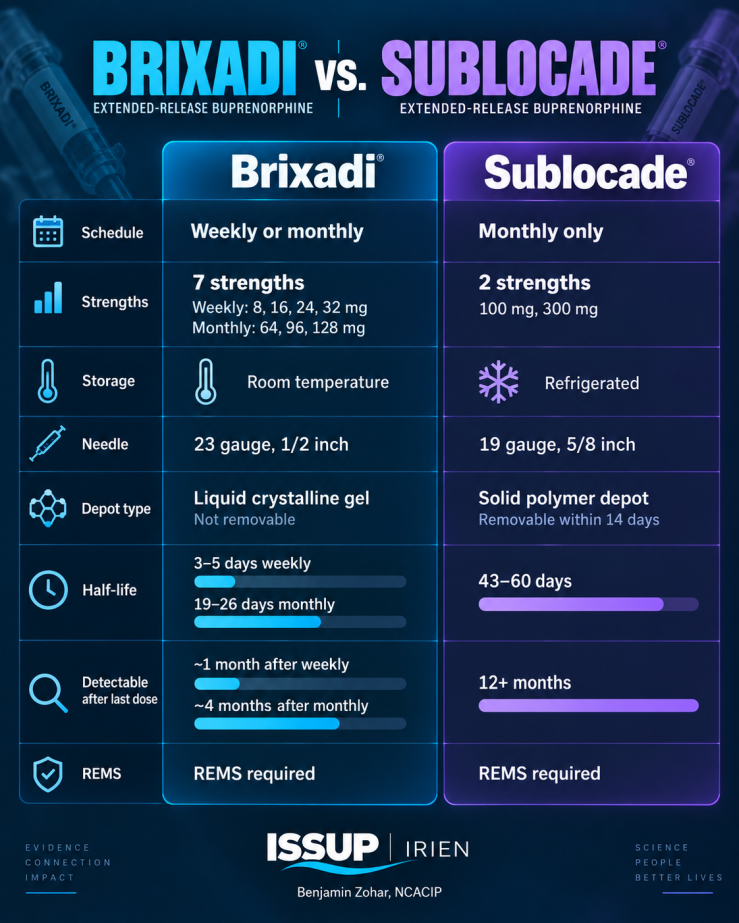
Brixadi's seven strengths and weekly option give clinicians finer control early in treatment; Sublocade's longer half-life gives more forgiveness for missed appointments once a patient is stable. Neither is "stronger" in a way the milligram labels can express.
Which one may fit a given patient?
Selection is individualized. Brixadi's weekly option can support more frequent reassessment and dose adjustment early in treatment, while either Brixadi Monthly or Sublocade may reduce visit frequency once treatment is stable. Storage requirements, injection characteristics, prior buprenorphine dose, adverse effects, patient preference, and insurance or formulary coverage can also influence the decision. These are product differences, not evidence that one medication is universally superior.
Brixadi vs. Suboxone: Injection vs. Daily Film
Is Brixadi Equivalent to Suboxone?
No. Both involve buprenorphine, but they are different products. Brixadi is an extended-release injection containing buprenorphine only and is given by a healthcare provider weekly or monthly. Suboxone is a transmucosal buprenorphine/naloxone product generally taken by the patient on a recurring schedule.
Suboxone is a daily sublingual film or tablet of buprenorphine plus naloxone that patients take themselves at home. Brixadi replaces that daily act with a weekly or monthly clinic injection of buprenorphine alone. In the Phase 3 trial, Brixadi was non-inferior to daily Suboxone-type dosing on the primary responder endpoint (16.9% versus 14.0%) and showed a statistically significant advantage on the cumulative distribution of opioid-negative assessments, driven by patients in the lower-adherence range. Among patients who were already mostly opioid-free, the two performed about the same.
| Feature | Brixadi | Suboxone |
|---|---|---|
| Ingredients | Buprenorphine | Buprenorphine + naloxone |
| Route | Subcutaneous injection by a clinician | Sublingual/buccal film or tablet, self-administered |
| Frequency | Weekly or monthly | Daily (sometimes split doses) |
| Where obtained | REMS-certified clinic | Any retail pharmacy with a prescription |
| Risk of diversion or missed doses | Very low; nothing goes home | Depends on the patient |
| Can it be started first? | No; requires a transmucosal test dose first | Yes, standard induction product |
| Dose adjustment speed | Slow; depot cannot be reversed | Same day |
| Typical fit | Adherence problems, unstable housing, diversion concerns, patient preference for fewer daily reminders of treatment | Induction, patients who value control over their own dose, pregnancy dose titration |
Patients who need the flexibility to change doses quickly, including during pregnancy, are usually better served by sublingual products. Patients who struggle to take a daily medication, who have had medication stolen or pressured away from them, or who simply want to stop thinking about pills every morning are the population long-acting injectables were built for. The FDA's medications for opioid use disorder overview lists all three buprenorphine forms, methadone, and naltrexone as equally legitimate options; the choice is clinical, not moral. For related buprenorphine questions involving kratom and 7-OH, see Does Suboxone Help Kratom / 7-OH Withdrawal? A New York–Focused Answer and Does Suboxone Help With Kratom Dependence?.
What Happens If You Take Suboxone While on Brixadi?
Patients should not add or change buprenorphine products on their own while receiving Brixadi. Transmucosal buprenorphine may be used in specific clinical situations, including induction or management of withdrawal after discontinuation, but supplemental dosing should be directed by the treating clinician because the Brixadi depot continues releasing buprenorphine.
How Do You Switch From Brixadi to Suboxone?
There is no one-size-fits-all self-conversion schedule. Brixadi continues releasing buprenorphine after the final injection, so a transition back to transmucosal buprenorphine should be individualized by the prescriber based on the formulation received, time since the last injection, symptoms, and clinical response.
How Long Does Brixadi Stay in Your System?
Does Brixadi Work Immediately?
Brixadi begins releasing buprenorphine after injection, but "working immediately" is not a reliable promise for every patient. Clinical effect depends on prior opioid and buprenorphine exposure, induction status, dose, injection site, and individual response. New patients are first given a transmucosal buprenorphine test dose specifically to establish tolerability before the depot injection is administered.
How Long Does Brixadi Take to Kick In?
Pharmacokinetic studies show that median time to peak buprenorphine concentration is about 24 hours for Brixadi Weekly and approximately 6 to 10 hours for Brixadi Monthly. Peak concentration is not the same thing as the exact moment a patient feels clinical benefit, so symptoms and response should be assessed by the treating clinician.
After steady state, buprenorphine from Brixadi Weekly remains detectable in blood for about 1 month after the last injection, and from Brixadi Monthly for about 4 months. The half-life is 3 to 5 days for the weekly product and 19 to 26 days for the monthly product, which is far longer than sublingual buprenorphine's 24 to 42 hours because the depot keeps releasing drug as it degrades. For the related sublingual formulation, see How Long Does Suboxone Stay in Your System?.
Three consequences follow from that:
- Drug testing: the FDA states the relationship between blood levels and urine detection has not been established for Brixadi. Buprenorphine is not detected by a standard opiate immunoassay; it requires a specific buprenorphine panel. A positive buprenorphine screen weeks after the last injection is expected and is not evidence of new use.
- Surgery and pain: a patient who stopped Brixadi Monthly two months ago still has active buprenorphine on the receptor. Anesthesia teams need to know, because opioid analgesics will be less effective and higher doses carry more toxicity risk.
- Drug interactions: starting or stopping a CYP3A4 inhibitor or inducer changes buprenorphine exposure, and a depot cannot be adjusted quickly. If a dose becomes excessive or inadequate and the interacting drug cannot be changed, the label directs switching back to a sublingual product.
Brixadi Withdrawal: What Happens When You Stop
Can You Just Stop Taking Brixadi?
Patients should not change or discontinue Brixadi treatment without discussing it with the prescribing clinician. Because the medication is released from a depot over an extended period, withdrawal after the final injection can be delayed. The FDA prescribing information recommends monitoring patients for signs and symptoms of withdrawal for several months after discontinuation.
Will Brixadi Cause Precipitated Withdrawal?
Precipitated withdrawal can occur if buprenorphine is started while a person who is physically dependent on a full opioid agonist still has sufficient agonist effect at the receptor. This is why the labeled initiation pathway for someone not already receiving buprenorphine uses a 4 mg transmucosal buprenorphine test dose after objective mild-to-moderate withdrawal appears before the first Brixadi Weekly injection.
Stopping Brixadi does not produce immediate withdrawal because the depot keeps releasing buprenorphine for weeks. When withdrawal does emerge it is typically milder than withdrawal from full agonists and delayed in onset. The FDA directs clinicians to monitor patients for several months after discontinuation and to use transmucosal buprenorphine if needed to manage symptoms.
Two distinct situations get confused under "Brixadi withdrawal":
- Precipitated withdrawal at the start. Buprenorphine displaces full agonists from the receptor. Given to someone whose fentanyl, heroin, or methadone is still active, it can cause abrupt, intense withdrawal. Brixadi's label prevents this by requiring a tolerated 4 mg transmucosal test dose before the first injection. Because a depot cannot be taken back, this step is not optional.
- Insufficient-dose withdrawal during treatment. Post-marketing reports describe withdrawal-type symptoms around the two-week mark that resolved when the dose was raised. Cravings, sweating, or restlessness late in a dosing interval usually mean the dose or site needs review, not that the medication has failed. For a closely related buprenorphine framework, see Signs Your Suboxone Dose Is Too Low (Cravings, Withdrawal & What to Do).
Patients should never attempt to taper or stop a long-acting injectable on their own schedule. Because there is no maximum recommended duration of treatment, the decision to stop is a planned clinical process, not an event.
What Patients Report About Brixadi
Searches for "Brixadi vs Sublocade reddit" and "Brixadi reviews" reflect real questions that the labels answer better than anonymous threads do:
- "There's a lump where I was injected." Expected. Injection-site pain, redness, and itching were each reported by 6% to 10% of trial patients, none severe. Sublocade's label tells patients to expect a lump for several weeks. What is not expected: heat, spreading redness, drainage, or an open sore. Those need same-day evaluation.
- "Weekly is annoying but I felt more in control." That is by design. The weekly product exists so that dose changes happen in days, not months, and so that patients new to treatment are seen every week.
- "I switched from Sublocade and felt off for a couple of weeks." Plausible. Sublocade's average and trough levels at 100 mg are higher than most sublingual doses, and steady-state levels between products do not match one to one. Report symptoms to the prescriber rather than waiting for the next appointment.
- "I missed my monthly shot by 10 days." For Brixadi Monthly the label window is one week either side; beyond that, the next dose is given as soon as possible. The long half-life means a delay of days is not a crisis, and it is also not a reason to skip the visit.
- "Can I take my Suboxone with it?" Only if the prescriber directs it. Transmucosal buprenorphine is used at induction and can be used to treat withdrawal after discontinuation, but adding it on top of a depot without direction defeats the purpose and adds sedation risk.
Brixadi Myths vs. Facts
| Myth | Fact |
|---|---|
| Brixadi is just an injectable Suboxone. | Brixadi contains no naloxone. Suboxone contains buprenorphine and naloxone. |
| Brixadi is stronger than Sublocade because it has more strengths. | The milligram numbers are not comparable; the two products release buprenorphine at different rates and the label pairs neither product's doses with the other's. |
| You can get Brixadi at a pharmacy with a prescription. | Brixadi is dispensed only to certified healthcare providers under the Brixadi REMS. Patients cannot receive it to self-administer. |
| If you stop Brixadi you go into withdrawal the next week. | The depot keeps releasing buprenorphine for about 1 month (weekly) or 4 months (monthly). Withdrawal, if any, is delayed and typically milder than full-agonist withdrawal. |
| Anyone can start on the monthly shot. | Brixadi Monthly is only for patients already on buprenorphine. New patients start with a test dose and Brixadi Weekly. |
| Brixadi will make you fail a drug test for opioids. | Standard opiate screens do not detect buprenorphine. A buprenorphine-specific test will be positive during treatment and for weeks to months after, which documents treatment rather than misuse. |
| Long-acting injections replace counseling. | The FDA label requires Brixadi be used as part of a complete treatment plan that includes counseling and psychosocial support. |
Common Brixadi Questions: Short Answers
What are the available doses of Brixadi?
Brixadi Weekly is available in 8 mg, 16 mg, 24 mg, and 32 mg strengths. Brixadi Monthly is available in 64 mg, 96 mg, and 128 mg strengths.
Can Brixadi be given every 3 weeks?
The FDA-approved intervals are every 7 days for Brixadi Weekly and every 28 days for Brixadi Monthly. A routine every-3-weeks regimen is not an approved schedule.
How should Brixadi be administered?
Only a healthcare professional should prepare and administer Brixadi. It is given as a single subcutaneous injection into the buttock, thigh, abdomen, or upper arm, with site rules that differ between weekly and monthly treatment.
Does Brixadi work immediately?
Brixadi begins releasing buprenorphine after injection, but the timing of clinical benefit varies. The label requires a test dose in patients not already receiving buprenorphine to establish tolerability before the first weekly injection.
What should you avoid while taking Brixadi?
Do not add alcohol, benzodiazepines, gabapentinoids, other sedatives, or additional opioids without discussing them with the treating clinician. Combining CNS depressants with buprenorphine can increase sedation and respiratory-depression risk.
Is Brixadi equivalent to Suboxone?
No. Brixadi is extended-release buprenorphine given by injection. Suboxone contains buprenorphine plus naloxone and is taken transmucosally.
Does Brixadi block opiates?
Buprenorphine's high receptor affinity can blunt the effects of other opioids. Brixadi demonstrated opioid blockade in a hydromorphone challenge study, but this does not eliminate overdose risk.
What is the recommended direct-to-inject protocol for Brixadi?
For patients not already receiving buprenorphine, the FDA-labeled pathway uses a 4 mg transmucosal buprenorphine test dose after objective mild-to-moderate withdrawal, followed—if tolerated—by 16 mg Brixadi Weekly and an additional 8 mg within 3 days to reach the recommended 24 mg first-week dose. Further adjustment belongs to the treating clinician.
Can you just stop taking Brixadi?
Do not stop or alter treatment without a clinician. Because Brixadi is long acting, withdrawal can be delayed after the final injection and monitoring may be needed for months.
What happens if I take Suboxone while on Brixadi?
Do not add Suboxone or another buprenorphine product without prescriber direction. Supplemental transmucosal buprenorphine can be used in certain clinical situations, but the depot continues releasing medication and unsupervised dosing can increase risk.
Does Brixadi cause weight gain?
Weight gain is not among the most common adverse reactions listed in the Brixadi prescribing information. Unexplained or persistent weight changes should be discussed with the treating clinician.
Is Brixadi stronger than Sublocade?
Not in a way that can be determined by comparing milligram labels. The products have different extended-release formulations, dose ranges, and pharmacokinetic profiles.
Can you drink alcohol while on Brixadi?
Alcohol can increase sedation and respiratory-depression risk with buprenorphine. Patients should discuss alcohol use with their healthcare professional.
Will Brixadi cause precipitated withdrawal?
It can if buprenorphine is initiated while sufficient full-opioid agonist effect remains. The labeled test-dose process is intended to reduce that risk before the first Brixadi injection.
How long does Brixadi take to kick in?
Median time to peak concentration is about 24 hours for Brixadi Weekly and 6 to 10 hours for Brixadi Monthly. The exact timing of symptom relief varies by patient and treatment context.
What are the common side effects of Brixadi?
Common adverse reactions in the prescribing information include injection-site pain, headache, constipation, nausea, injection-site redness, injection-site itching, insomnia, and urinary tract infection.
How do you switch from Brixadi to Suboxone?
The transition should be individualized by the prescriber because Brixadi continues releasing buprenorphine after the last injection. Timing depends on the prior formulation, time since the last injection, symptoms, and clinical response.
Brixadi Cost, Copay Assistance, and Finding a Provider
Brixadi is billed as a clinician-administered medication (a "buy-and-bill" or specialty-pharmacy product), not as a retail prescription, so the patient's cost depends on whether the plan covers it under the medical or pharmacy benefit, whether prior authorization is required, and whether the clinic participates in the manufacturer's copay program. Braeburn operates a copay assistance program for commercially insured patients; federal law generally excludes Medicare, Medicaid, TRICARE, and VA beneficiaries from manufacturer copay cards. Coverage and out-of-pocket costs vary by plan and state, so current eligibility should be verified before relying on a specific price.
To find a Brixadi provider, start with the current buprenorphine prescriber, an opioid treatment program, an addiction-medicine clinic, or the official Brixadi REMS resources. Availability varies because Brixadi is not dispensed directly to patients through ordinary retail pharmacy channels.
When to Seek Help
Call 911 for slowed or stopped breathing, unresponsiveness, blue lips, or a seizure, and give naloxone if it is available. Contact the prescribing clinic promptly for a hot, draining, or ulcerated injection site, jaundice or dark urine, severe sedation, or withdrawal symptoms that emerge during treatment. Anyone who is physically dependent on opioids and considering buprenorphine treatment should be evaluated by a clinician who can supervise induction. For U.S. treatment information, the SAMHSA National Helpline is available at 1-800-662-4357.
Frequently Asked Questions About Brixadi
What is Brixadi used for?
Brixadi is used to treat moderate to severe opioid use disorder in adults who have tolerated a transmucosal buprenorphine dose or are already on buprenorphine. It is not approved for pain, and it is not for opioid-naïve people.
Is Brixadi the same as Sublocade?
No. Both are extended-release buprenorphine injections, but Brixadi offers weekly and monthly dosing in seven strengths, is stored at room temperature, and clears in about 1 to 4 months. Sublocade is monthly only in two strengths, is refrigerated, and can remain detectable for a year or more.
Is Brixadi the same as Suboxone?
No. Suboxone is a daily sublingual film or tablet containing buprenorphine and naloxone that patients take at home. Brixadi is a clinician-administered weekly or monthly injection containing buprenorphine only.
Does Brixadi contain naloxone?
No. Brixadi contains buprenorphine only. The naloxone in Suboxone is a deterrent against injecting the film; it is unnecessary in a product a clinician injects.
What are the Brixadi weekly and monthly doses?
Weekly: 8, 16, 24, and 32 mg. Monthly: 64, 96, and 128 mg. Weekly 16, 24, and 32 mg correspond to monthly 64, 96, and 128 mg when transitioning between formulations.
Where is Brixadi injected?
Under the skin of the buttock, thigh, abdomen, or upper arm. Weekly injections rotate sites and avoid reusing a site for 8 weeks; monthly injections do not require rotation. The upper arm gives about 10% lower drug levels and is restricted for new weekly patients until steady state.
Can you inject Brixadi yourself?
No. Brixadi is prepared and administered only by a healthcare provider and is dispensed only to certified providers under the Brixadi REMS. It is never given to patients to take home.
Does Brixadi need to be refrigerated?
No. Brixadi is stored at room temperature (68°F to 77°F). Sublocade, by contrast, is refrigerated and can stay at room temperature for up to 12 weeks before use.
How long does Brixadi stay in your system?
From steady state, about 1 month after the last weekly injection and about 4 months after the last monthly injection in blood. Urine detection may last longer and has not been formally correlated with blood levels.
Does Brixadi get you high?
In patients who are opioid-dependent and dosed correctly, Brixadi relieves withdrawal and cravings without producing euphoria, and it blocks the drug-liking effect of other opioids. Buprenorphine is still a Schedule III opioid with a ceiling effect, and misuse, particularly with alcohol or benzodiazepines, can be fatal.
Is Brixadi a controlled substance?
Yes. Buprenorphine is Schedule III, and Brixadi's label carries the CIII marking. Certified clinics store and dispose of it under Schedule III rules.
Is "Bridaxi" or "Braxadi" the same medication?
Those are common misspellings of Brixadi. The FDA-approved brand name is Brixadi, made by Braeburn. The same formulation is marketed outside the U.S. as Buvidal.
Related Clinical Resources
- How Long Does Suboxone Stay in Your System?
- Signs Your Suboxone Dose Is Too Low (Cravings, Withdrawal & What to Do)
- Does Suboxone Help Kratom / 7-OH Withdrawal? A New York–Focused Answer
- Does Suboxone Help With Kratom Dependence?
- 7-Hydroxymitragynine (7-OH) and Kratom Withdrawal: Clinical Insights and Buprenorphine-Based Management
- How Long Island Families Can Find Safe, Licensed Addiction Treatment
- Integrated Recovery & Intervention Education Network (IRIEN)
Source Verification
The core dosing, administration, conversion, pharmacokinetic, safety, and REMS statements in this article are based primarily on the current U.S. FDA-approved Brixadi prescribing information and medication guide. Comparative Sublocade statements are based on the current U.S. Sublocade prescribing information. Clinical-study details are drawn from the trials identified in the prescribing information and ClinicalTrials.gov. Manufacturer patient materials are used only where they are consistent with the FDA-approved label.
References
- U.S. Food and Drug Administration. BRIXADI (buprenorphine) extended-release injection for subcutaneous use, CIII: Prescribing Information. Braeburn Inc. Revised December 2025.
- U.S. Food and Drug Administration. SUBLOCADE (buprenorphine extended-release) injection for subcutaneous use, CIII: Prescribing Information. Indivior Inc. Revised December 2025.
- U.S. Food and Drug Administration. Information about Medications for Opioid Use Disorder (MOUD).
- Substance Abuse and Mental Health Services Administration. Buprenorphine.
- Braeburn Inc. Brixadi REMS Program.
- ClinicalTrials.gov. NCT02651584: A Phase 3 Study of CAM2038 (Brixadi) Versus Sublingual Buprenorphine/Naloxone for Opioid Use Disorder. NCT02611752: Opioid Blockade Study of CAM2038.
- National Institute on Drug Abuse. Medications to Treat Opioid Use Disorder Research Report.
About the Author
Benjamin Zohar, NCACIP, is a Nationally Certified Advanced Clinical Intervention Professional and ISSUP network moderator specializing in addiction intervention, treatment navigation and emerging substance-use risks. He publishes evidence-informed resources addressing counterfeit medications, fentanyl exposure, benzodiazepine safety, kratom dependence and concentrated 7-hydroxymitragynine products. His work published through ISSUP has been cited or referenced by GoodRx, The Washington Post, WIRED and Newsweek.
Written by: Benjamin Zohar, NCACIP
Medical Review
Medically reviewed by: Brandon McNally, RN
Medical Disclaimer
This article is published for educational and public-health purposes only and does not provide individualized medical advice, diagnosis, or a dosing or tapering schedule. Dosing tables summarize FDA prescribing information for clinician and patient education; do not start, stop, or alter any prescription medication without your treating clinician. Call emergency services immediately for seizures, breathing difficulty, loss of consciousness, or severe confusion.