
Youth Voices for Prevention: Creative Pathways to Address Violence, Crime, and Build Safer Communities
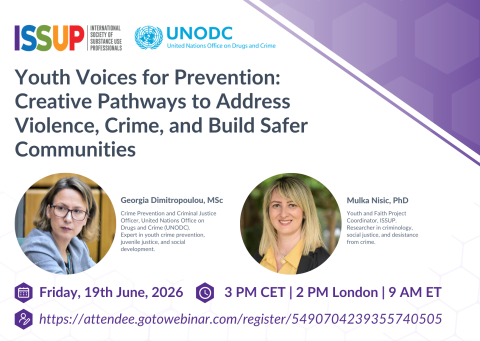
ISSUP Global, in collaboration with UNODC, presents 'Youth Voices for Prevention: Creative Pathways to Address Violence, Crime, and Build Safer Communities.'
Date: Friday, 19th June 2026
Time: 3 PM CET | 2 PM London | 9 AM ET
Language: The event will be in English with interpretation available in Spanish.
This webinar will explore the role of meaningful youth participation in violence and crime prevention and highlight how creative expression can be used to amplify youth voices, foster resilience, challenge stereotypes, and contribute to safer and more inclusive communities. The session will also introduce the United Nations Office on Drugs and Crime (UNODC) Global Youth Campaign on Youth Violence and Crime Prevention as an example of a youth-centred initiative that promotes engagement, prevention, and positive social change.
Young people are often the focus of discussions on violence and crime, yet their voices are rarely at the centre of decision-making processes. This webinar will introduce the UNODC Global Youth Campaign on Youth Violence and Crime Prevention, a global initiative inviting young people aged 18–29 to share their experiences, ideas, struggles, and hopes through creative expression.
Participants will learn about the campaign's objectives, eligibility criteria, submission formats, and opportunities for engagement. The session will highlight why youth participation is essential for effective crime prevention and how creative storytelling can promote healing, belonging, resilience, and positive social change.
The webinar will also discuss the importance of listening to young people, including those who have experienced, observed, or been affected by violence, crime, and contact with the criminal justice system. Participants will have an opportunity to ask questions about the campaign and explore ways to encourage youth participation through their organisations and networks.
Topics will include:
- Understanding youth violence and crime through a prevention lens
- The role of youth participation in building safer communities
- Creative expression as a tool for prevention, advocacy, and social change
- Overview of the UNODC Global Youth Campaign
- Submission process, eligibility, and key deadlines
- Opportunities for youth networks and organisations to support the initiative
- Interactive Q&A session
Intended audience:
General population of Young people aged 18–29, Youth leaders, Early Career Professionals who have personal experience of or have witnessed crime and violence and want to have their voice heard. And:
- Prevention practitioners
- Community organisations
- Educators and social workers
- Criminal justice professionals
- Researchers and academics
- NGOs and civil society organisations
- ISSUP National Chapters and members
- UNODC partners and stakeholders who work with youth on crime related prevention
Learning Outcomes:
At the end of the webinar, participants will:
-
Describe the aims and objectives of the UNODC Global Youth Campaign on Youth Violence and Crime Prevention.
-
Explain the importance of youth engagement and participation in crime prevention efforts.
-
Identify how creative expression can be used to promote prevention, healing, resilience, and positive social change.
-
Understand the campaign submission requirements, timelines, and opportunities for participation.
-
Recognise ways organisations and youth networks can support and promote youth-led prevention initiatives.
References:
- United Nations Office on Drugs and Crime. A global youth campaign on preventing youth crime and violence (2026). https://www.unodc.org/unodc/justice-and-prison-reform/global-youth-campaign-2026.html
Presenter:
Georgia Dimitropoulou, MSc,
Ms. Georgia Dimitropoulou is working, as of 2019, as a Crime Prevention and Criminal Justice Officer at the UNODC HQ, Department of Treaty Affair, Crime Prevention and Criminal Justice Section in Vienna.
In her current work, she promotes evidence-informed crime prevention with a focus on social developmental and community-based responses that are addressing root causes of youth violence and crime. Ms Dimitropoulou also coordinates UNODC work under its Global initiative on Youth Crime Prevention through Sport that promotes the use of sport as a tool for empowerment and social inclusion, in building youth and community resilience to minimise risk factors and strengthen positive factors for your violence and crime.
Prior to joining UNODC, Georgia Dimitropoulou worked for over 17 years in forced migration and asylum, human trafficking and juvenile justice holding various posts at the national and international level including with the Greek Ministry of Justice, local authorities, the European Union Agency on Fundamental Rights (FRA), and the NGO sector. In the course of her work, she also cooperated as an external expert among others with the Council of Europe, the UNODC and the European Border and Coast Guard Agency (FRONTEX) and has contributed substantially to several publications on her areas of expertise. She has an academic background in social work and holds Master’s Degrees in Comparative European Social Studies and on Children’s Rights.
Moderator:
Mulka Nisic, PhD
Dr Mulka Nisic holds a PhD in Business, Law and Social Sciences specialising in Criminology and Social Justice, and an MSc in Desistance from Crime. Her work focuses on the intersection of substance use and drug related offending, with particular attention to the social and structural factors shaping vulnerability to substance use, crime involvement, as well as pathways toward resilience, recovery, and desistance.
She currently serves as Faith and Youth Project Coordinator at the International Society of Substance Use Professionals (ISSUP), where she leads global activities under the Faith and Youth Workplan aimed at strengthening the workforce in delivering community and faith-based responses to substance use as well as supporting youth engagement, professional capacity building of early career professionals, and cross-regional and global knowledge exchange.
Webinars and online events delivered and hosted by the International Society of Substance Use Professionals (ISSUP) are provided for informational purposes only. They are educational in nature and do not constitute medical advice, diagnosis or treatment.
- ISSUP members can join Networks to comment – Sign in or become a member