
DEA Adjusts Stimulant Production Quotas Amid Ongoing ADHD Medication Shortages in 2025
Author: Benjamin Zohar, NCACIP – Nationally Certified Advanced Clinical Intervention Professional
Overview
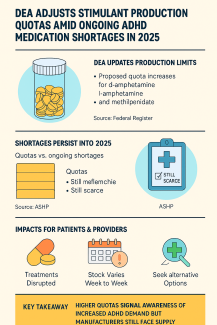
Despite recent updates to national stimulant production quotas, shortages of Adderall and related ADHD medications continue to disrupt treatment across the U.S. in late 2025. While the Drug Enforcement Administration (DEA) revised its Aggregate Production Quotas (APQs) in response to rising prescription demand, pharmacies remain constrained, and patients face mounting challenges.
DEA Increases 2024–2025 Production Quotas
In response to growing ADHD diagnoses and prescription volumes, the DEA issued revised production quotas for d-amphetamine, l-amphetamine, and methylphenidate. These changes were formally announced via the Federal Register in late 2024.
- Increased APQs for Adderall ingredients signal federal acknowledgment of unmet treatment demand
- However, quota increases alone have not resolved widespread shortages
Ongoing Shortages: What the Data Shows
Despite the DEA’s adjustments, national medication shortages persist into late 2025. The American Society of Health-System Pharmacists (ASHP) confirms limited availability across both immediate- and extended-release formulations:
- Amphetamine Mixed Salts IR – ASHP Shortage Listing
- Amphetamine Mixed Salts XR – ASHP Shortage Listing
These shortages affect both generic and brand-name products, and reflect systemic manufacturing, distribution, and raw material issues.
Perspective: Stimulant Demand in 2025
According to 2023 data, over 41 million prescriptions for Adderall were filled in the U.S., representing more than 2.1 billion pills annually — roughly 5.7 million doses per day. Despite this, manufacturers faced stringent production limits until very recently.
That mismatch between need and supply remains a driving force behind today’s shortages.
Stimulant Shortage Impacts: New Research
Peer-reviewed research published by the American Academy of Pediatrics confirmed the nationwide disruption in amphetamine dispensing:
The study documented:
- A decline in stimulant dispensing during peak shortage months
- Substitution patterns that altered clinical treatment plans
- Increased pressure on families and schools to adapt
Why Quotas Are Not a Quick Fix
The DEA's quota increase is regulatory progress, but it does not solve:
- Active pharmaceutical ingredient (API) shortages
- Production and staffing limitations at manufacturing sites
- Pharmacy-level distribution gaps — especially in rural and underserved areas
- Insurance and access disparities
What Patients and Providers Should Know
Stimulant access remains highly variable by location and manufacturer. Patients are advised to:
- Check stock at multiple pharmacies (including local independents)
- Ask prescribers about equivalent IR/XR substitutions
- Request documentation for insurance overrides when necessary
- Use only FDA-approved pharmacies
Also see: FDA Drug Shortages – Info for Patients and Providers
Related Reading
- 2025 ADHD Stimulant Shortage: Patient & Provider Guidance – A deeper dive into treatment navigation and state-specific support options
Conclusion
While the DEA’s quota adjustments in 2024–2025 are a step toward addressing the stimulant medication crisis, the underlying supply-chain, regulatory, and clinical bottlenecks remain. Shortages continue to impact continuity of care, and proactive planning is essential at every level — from pharmacies to public policy.
About the Author
Benjamin Zohar, NCACIP is a Nationally Certified Advanced Clinical Intervention Professional, founder of Intervention NY, and a contributor to international addiction education networks through ISSUP, NAADAC, and NAMI. He focuses on ethical treatment planning, crisis stabilization, and access education.