World No Tobacco Day
Every year, on 31 May, the World Health Organization (WHO) and global partners celebrate World No Tob
Join as an individual or organization
Every year, on 31 May, the World Health Organization (WHO) and global partners celebrate World No Tob
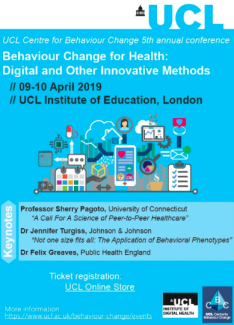
The UCL Centre for Behaviour Change (CBC), in collaboration with the UCL Institute for Digital Health, is delighted to confirm its fifth behaviour change conference.
The 5th annual CBC conference will invite academia and industry to present on health-related behaviour using digital/not digital and hybrid technologies.
Though it has become mandatory for public health facilities to become smoke-free it has been difficult to implement this policy in particular in detox, drug and alcohol units and mental health units.
Particularly complex in-patients in detox units have smoking patients objecting to a smoke free environment, commonly flout regulations, become argumentative and often self-discharge.
IOGT International invites you to an innovative space to jointly explore comprehensive solutions to the world drug problem. Welcome to this much-needed and innovative conference.
Objective: This small-scale 2-day workshop targets researchers interested in unfolding the relationship between science and policy-making in questions of public health and lifestyle regulation (concerning for example alcohol, drugs, and tobacco use; gambling; nutrition)
Youth alcohol consumption is declining across most high-income nations, often alongside concurrent decreases in drug use and smoking. Researchers are increasingly focusing on the nature and underlying reasons for this decline.
The Kettil Bruun Society is holding a thematic meeting to discuss the nature of these trends.
The programme will be organised around the following themes:
Advocates of prevention have long touted its value, but researchers’ success in quantifying the economic benefits of preventive interventions have often been limited by fragmented methods and practice.
A number of efforts by the National Institutes of Health (NIH), National Academies, federal agencies, and foundations over the last decade have led to improvements in these methods.