
All Resources for 'Law Enforcement & Supply Reduction'

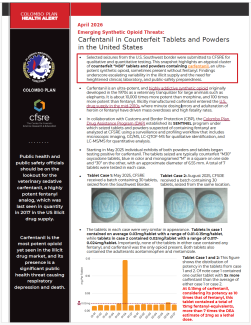
Carfentanil Detected in Counterfeit Tablets and Powders: What the Substance Use Workforce Should Know

Format
Community update
Themes
Policy
Data
Criminal Justice 
Emerging substances 
Law Enforcement
Border Control
Police 
Prisons / Corrections
Supply & Market Disruption
A new health alert reports carfentanil in counterfeit “M30” tablets and powders seized at the United States Southwest border. Carfentanil is an extremely potent synthetic opioid, and some tablets contained it without any fentanyl. The findings highlight how the appearance of an illicit tablet or powder cannot reliably indicate its contents or strength. Prevention, treatment and recovery professionals should reinforce overdose awareness, naloxone access and timely connections to care. Law enforcement, laboratories and public health partners should follow safe handling protocols, test comprehensively and share emerging drug market information quickly.
Substance Use and Health Competencies for All Prescribers

Publication Date
Format
Guide
Themes
Prevention
Treatment
Recovery Support
Quality Assurance
Best Practice Guidelines
Professional Development
Resilience and Coping Strategies

Developed by the Canadian Centre on Substance Use and Addiction (CCSA), the Workforce Competencies provide an evidence-informed framework outlining the knowledge, skills, values and behaviours needed by professionals working in substance...

Rehabilitation and Re-entry Programmes for Justice-Involved Individuals and Their Effectiveness in Social Reintegration: A Systematic Review

Publication Date
Format
Scientific article
Themes
Community-Based
Recovery Support
Peer and Community Support
Policy
Law
Criminal Justice 
Service Provision & Engagement 
Law Enforcement
Police 
Prisons / Corrections
Probation & Parole
Responding to Drug-Related Offending 
Health & Justice Responses 
Justice and Diversion
Rehabilitation and Re-Entry Services

Prison rehabilitation and community re-entry programmes implemented during incarceration or in the transitional period serve as significant mechanisms for facilitating justice-involved individuals in their post-release adaptation. This...

Psychosocial determinants of recidivism risk among incarcerated individuals with a history of substance use: A systematic review

Publication Date
Format
Scientific article
Themes
Treatment
Treatment
Recovery Support
Recovery-Oriented Services
Populations
Men
Women
Mental Health
Law
Criminal Justice 
Service Provision & Engagement 
Law Enforcement
Prisons / Corrections
Probation & Parole
Responding to Drug-Related Offending 
Health & Justice Responses 
Justice and Diversion
Rehabilitation and Re-Entry Services

The prevalence of recidivism among individuals with a history of substance use and incarceration remains a significant concern for criminal justice systems worldwide. With significant social and economic ramifications, preventing people...

The product may not be what it says: What emerging synthetic drugs and dangerous mixtures mean for practice

Publication Date
Format
Toolkit
Themes
Prevention
Treatment
Recovery Support
Psychoactive Substances
Populations
Law Enforcement
The clearest message from our recent ISSUP Global webinar was a simple but important one: we should stop assuming that an unregulated drug product contains only what it is sold as containing. That uncertainty now has direct implications for prevention, clinical care, recovery support, toxicology, law enforcement, policy and the administration of justice.

Do Drug Diversion Schemes Work? Insights from the Thames Valley Police Drugs Diversion Pilot

Format
Scientific article
Themes
Ancillary Services
Data
Criminal Justice 
Service Provision & Engagement 
Law Enforcement
Police 
Responding to Drug-Related Offending 
Health & Justice Responses 
Justice and Diversion
Rehabilitation and Re-Entry Services

This paper examines the development and early outcomes of the Thames Valley Police Drugs Diversion Pilot in West Berkshire, which offers people found in possession of drugs an opportunity to engage with treatment rather than receive a...

Drug Diversion Schemes Linked to Lower Reoffending Rates, New Research Finds

Format
News
Themes
Data
Criminal Justice 
Service Provision & Engagement 
Law Enforcement
Police 
Responding to Drug-Related Offending 
Health & Justice Responses 
Justice and Diversion
Rehabilitation and Re-Entry Services

New research examining more than 62,000 criminal incidents across 13 police forces in England found that police-led drug diversion schemes are associated with significantly lower reoffending rates than traditional prosecution for drug...

The introduction of drug Arrest Referral schemes in London: A partnership between drug services and the police

Format
Scientific article
Themes
Treatment
Ancillary Services
Data
Criminal Justice 
Service Provision & Engagement 
Law Enforcement
Police 
Health & Justice Responses 
Justice and Diversion
Rehabilitation and Re-Entry Services

Arrest Referral (AR) schemes in London were established to connect people who use drugs with treatment services at the point of arrest through collaboration between police and drug service providers. Based on interviews with police officers...

Strengthening Public Health and Security in the new African Union Strategy and Plan of Action on Drug Control and Crime Prevention

Publication Date
Format
ISSUP Webinar
Themes
Prevention
Public Health
Regulatory Control of Substances
Partner Organisation
ISSUP Global, in collaboration with the African Union, presents a webinar on Strengthening Public Health and Security: African Union Strategy and Plan of Action on Drug Control and Crime Prevention.

Is it time for Bangladesh to rejig its rehabilitation policies on mobile addiction in children

Publication Date
Format
Opinion piece, commentary
Themes
Prevention
School-Based
Populations
Family
Regulatory Control of Substances

Just the other day a distraught parent came into my office looking for a rehab center for their teen. The crisis was not substance abuse but smartphone addiction. The situation has reached a level where the child experiences a great deal of...