All Resources for 'Community-Based Prevention'

A systematic review of recovery high schools and collegiate recovery programs for building recovery capital among adolescents and emerging adults

Publication Date
Format
Scientific article
Themes
Recovery Support 
Recovery Support
Peer and Community Support
Recovery-Oriented Services
Populations
Children, Adolescents & Youth 

Introduction: 

Educational settings represent a prime opportunity for reaching adolescents and young adults (ages 12–27) experiencing substance use disorders (SUD). Recovery high schools (RHSs) were established to help adolescents in...


Recovery High Schools: A Descriptive Study of School Programs and Students

Publication Date
Format
Scientific article
Themes
Recovery Support 
Recovery Support
Peer and Community Support
Recovery-Oriented Services
Populations
Children, Adolescents & Youth 

High schools specifically designed for students recovering from a substance use disorder (substance abuse or dependence) have been emerging as a continuing care resource since 1987. This study of 17 schools provides the first systematic...

What is a Recovery High School?

Format
Website
Themes
Recovery Support 
Recovery Support
Peer and Community Support
Populations
Children, Adolescents & Youth 
Mental Health

This resource from the The Association of Recovery Schools explains the role of recovery high schools, which are secondary schools designed specifically to support students recovering from substance use disorders and co-occurring mental...

Understanding recovery capital for addiction recovery in adolescence and young adulthood

Publication Date
Format
Scientific article
Themes
Recovery Support 
Recovery Support
Peer and Community Support
Recovery-Oriented Services
Populations
Children, Adolescents & Youth 

In 2017, the Recovery Capital for Adolescents Model (RCAM) was proposed to highlight needs of adolescents in recovery (1), building on the seminal work of William Cloud and Robert Granfield (2). Research since the RCAM was proposed has...

Are Collegiate Recovery Programs worth the investment?

Format
Scientific article
Themes
Recovery Support 
Recovery Support
Peer and Community Support
Recovery-Oriented Services
Populations
Children, Adolescents & Youth 

The first collegiate recovery program was founded at Brown University in 1977. Since then, these programs have seen explosive growth, with 136 currently in operation. Universities are often tasked with determining whether programs are worth...

Connecting Evidence, Prevention, Law Enforcement and Community Action: Key Insights from ISSUP 2026

Format
Reading List
Themes
Faith-Based Strategies 
Recovery Support 
Treatment
Prevention
Prevention
Community-Based
Faith-Based
Family-Based
School-Based
Treatment
Faith-Based
Behavioural Therapy Interventions
Treatment Settings
Recovery Support
Faith-Based
Peer and Community Support
Psychoactive Substances
Addiction
Populations
Children, Adolescents & Youth 
Quality Assurance
Best Practice Guidelines
Implementation Science
Professional Development
Public Health
Global Health Perspectives
Policy Advocacy
Mental Health
Workforce Mental Health and Well-Being
Policy
Law
Data
Criminal Justice 
Law Enforcement
Border Control
Police 
Supply & Market Disruption
Regulatory Control of Substances
Responding to Drug-Related Offending 
Health & Justice Responses 
Justice and Diversion
Reading List

How do we go about translating evidence into effective action, strengthen prevention, address drug-related crime, improve access to treatment and recovery support, and build safer, healthier communities?

This age-old question was explored...

Para-Methoxymethamphetamine (PMMA) in tablets sold as ecstasy: Why this matters across our workforce

Publication Date
Format
Community update
Themes
Prevention
Treatment
Recovery Support
Psychoactive Substances
Public Health
Law Enforcement
Supply & Market Disruption
UNODC reports increasing PMMA detections in tablets sold as ecstasy in Europe, raising serious toxicity concerns. The alert encourages coordinated information sharing across prevention, treatment, recovery and law enforcement. It does not confirm local circulation, but prompts a review of local early warning responses.

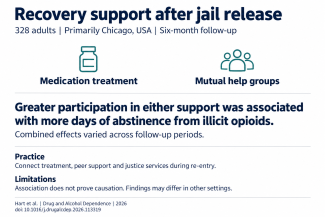
Adults with Problematic Opioid Use Released from Jail: Mutual Help Groups and Medication Support Contribute to a Greater Likelihood of Opioid Abstinence

Publication Date
Format
Scientific article
Themes
Treatment
Treatment Settings
Recovery Support
Peer and Community Support
Recovery-Oriented Services
Populations
Other Marginalized Groups
Law Enforcement
Prisons / Corrections
A recent study found that medication treatment and mutual help group participation were each associated with more days of abstinence from illicit opioids after jail release. Their combined benefits were less clear and varied across follow-up periods. For ISSUP practitioners, the findings highlight the value of connecting treatment, recovery support and justice services during re-entry. The study does not establish causation, and findings from this US sample may not apply equally in other settings.

From Evidence to Practice: Advances in Substance Use Disorder Care

Format
Report
Themes
Prevention
Community-Based
Family-Based
School-Based
Treatment
Quality Assurance
Best Practice Guidelines
Other
Professional Development
Public Health
Policy

Evidence-based interventions can improve prevention, treatment and recovery outcomes, but knowing what works does not guarantee that people will benefit. Effective responses depend on trained professionals, supportive systems, coordinated...

Addressing Youth Substance Use and Crime: Risk Factors and Strategies

Format
Report
Themes
Prevention
Community-Based
Populations
Family
Children, Adolescents & Youth 
Quality Assurance
Public Health
Global Health Perspectives
Law Enforcement
Police 
Responding to Drug-Related Offending 
Health & Justice Responses 

Protecting young people from substance use and crime: building safer communities and pathways to support

Young people's involvement in substance use and crime cannot be understood without considering the environments in which they grow up...