Directorio de Programas de Prevención, Tratamiento, Rehabilitación y Recursos Comunitarios de Problemas Asociados al Consumo de Sustancias Psicoactivas en Costa Rica Marzo 2022
Farhadian, N., Karami Matin, B., Farnia, V. et al. The prevalence of people who inject drugs among those with HIV late presentation: a meta-analysis. Subst Abuse Treat Prev Policy 17, 11 (2022). https://doi.org/10.1186/s13011-022-00439-5
La diagnosi precoce della sindrome da immunodeficienza acquisita consente alle persone infette di utilizzare la profilassi contro le infezioni opportunistiche e iniziare il trattamento immediato per le complicanze secondarie. Le persone che ricevono un trattamento beneficiano di un maggiore sostegno sociale e, soprattutto, cambiano il loro comportamento per evitare che il virus si diffonda ad altri. Uno dei principali metodi di trasmissione dell'HIV è attraverso iniezioni di farmaci, e questo gruppo è responsabile della diffusione dell'HIV poiché ignorano la loro malattia. La coesistenza dell...
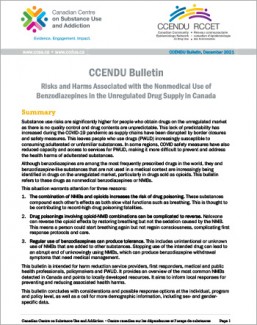
Substance use risks are significantly higher for people who obtain drugs on the unregulated market as there is no quality control and drug contents are unpredictable. This lack of predictability has increased during the COVID-19 pandemic as supply chains have been disrupted by border closures and safety measures. This leaves people who use drugs (PWUD) increasingly susceptible to consuming adulterated or unfamiliar substances. In some regions, COVID safety measures have also reduced capacity and access to services for PWUD, making it more difficult to prevent and address the health...
I clienti non sono "resistenti" - non sono adeguatamente riscaldati al cambiamento e, come medici, è nostro compito aiutarli a ridurre la loro ansia, rimanere impegnati nel processo e aumentare la loro capacità emotiva, fisica...
Studi limitati esaminano come le tradizionali pratiche di guarigione dei nativi americani / nativi dell'Alaska e occidentali vengono combinate nel trattamento per i clienti indigeni. Questo webinar discuterà le modalità di...
Johansson, M., Sinadinovic, K., Gajecki, M., Lindner, P., Berman, A. H., Hermansson, U., & Andréasson, S. (2020). Internet-based therapy versus face-to-face therapy for alcohol use disorder, a randomized controlled non-inferiority trial. Addiction, [Epub ahead of print]. Doi: 10.1111/add.15270
Dal momento che ci siamo spostati così tanto online, ecco uno studio clinico che confronta la consegna online di CBT con CBT faccia a faccia e ha trovato risultati simili.
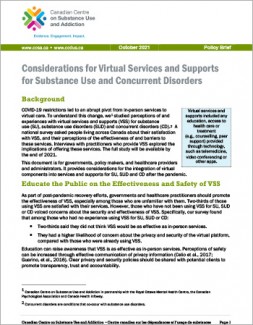
Il Canadian Centre for Substance Use and Addiction (CCSA) in collaborazione con il Royal Ottawa Mental Health Centre, la Canadian Psychological Association e Canada Health Infoway, ha raccolto dati nazionali sull'esperienza e la percezione dei servizi e dei supporti virtuali, compresa l'istruzione e l'accesso all'assistenza sanitaria o al trattamento.
Le restrizioni di sicurezza COVID-19 hanno portato alla necessità di servizi online e telefonici per sostituire la consulenza e i supporti faccia a faccia. Le persone che usano sostanze stanno vivendo i servizi virtuali in modo diverso a seconda...
ISSUP Ucraina è lieta di presentare il secondo webinar della sua serie in tre parti su "Salute mentale dei giovani e sostanza". Il secondo webinar si concentrerà specificamente sui disturbi dell'umore nei bambini e negli adolescenti.
UNODC PTRS is looking for civil society service providers offering drug use disorder treatment or prevention services in humanitarian settings, all over the world.
The abstract submission deadline EXTENDED! Abstract submissions for our event taking place online and in person in Abu Dhabi: 11-16th May, 2022 has been extended to 31st October! Find out more about the event and submit your abstract: issup.net/event2022
ICUDDR, INL, ISSUP and NRC are partnering to host a global in person and online event from 11th – 16th May 2022 in Abu Dhabi, UAE. We welcome abstract submissions for sub-plenary and poster presentations at the event. DEADLINE EXTENDED!
Daniel Wolfe, Roxanne Saucier, Reprint of: Biotechnologies and the future of opioid addiction treatments, International Journal of Drug Policy, Volume 94, 2021, 103273, ISSN 0955-3959, https://doi.org/10.1016/j.drugpo.2021.103273.
Biotechnological treatment, including addiction treatment, is the way of the future. Researchers and pharmaceutical companies praise depot injections, agonist/antagonist implants, deep brain stimulation, and hapten conjugate vaccines as medicine's greatest chance for reducing illegal usage, reducing the danger of overdose and severe withdrawal, and preventing drug diversion to criminal markets.
Old conflicts around ideas of addiction and treatment are revealed by marketing and the use of new technologies: between medical condition and will disorder, between criminal justice and health, and...
Olga Perski, PhD, Noreen L Watson, PhD, Kristin E Mull, MS, Jonathan B Bricker, PhD, Identifying Content-Based Engagement Patterns in a Smoking Cessation Website and Associations With User Characteristics and Cessation Outcomes: A Sequence and Cluster Analysis, Nicotine & Tobacco Research, Volume 23, Issue 7, July 2021, Pages 1103–1112, https://doi.org/10.1093/ntr/ntab008
Tobacco smoking is the greatest cause of sickness and early death worldwide, with 8 million people dying each year from a smoking-related condition. The use of pharmaceutical or behavioural assistance improves smokers' chances of quitting; nonetheless, the majority of smoking cessation efforts are unassisted.
Engagement with web-based smoking cessation interventions is a strong predictor of data retention in clinical trials and successful behaviour change.
WebQuit is a web-delivered smoking intervention based on Acceptance and Commitment Therapy (ACT), which suggests that psychological...
This manual provides a step-by-step guide for those involved in planning and managing infectious diseases and drug services, focusing on how to identify barriers to and opportunities for improving provision of HCV testing and access to treatment for people who use drugs.
Guerrero, E., Amaro, H., Kong, Y. et al. Gender disparities in opioid treatment progress in methadone versus counseling. Subst Abuse Treat Prev Policy 16, 52 (2021). https://doi.org/10.1186/s13011-021-00389-4
The high dropout rate (75%) in opioid use disorder (OUD) treatment among women and racial/ethnic minorities in the United States necessitates a better knowledge of the factors that contribute to treatment success. While therapy and medication for OUD are considered the top standard of care in substance use disorder (SUD) treatment, many people with OUD receive just counseling or methadone-only therapies. This study compares gender inequalities in methadone-based treatment plan progress to counseling-based programs in one of the biggest SUD treatment systems in the United States.
Herring AA, Vosooghi AA, Luftig J, et al. High-Dose Buprenorphine Induction in the Emergency Department for Treatment of Opioid Use Disorder. JAMA Netw Open. 2021;4(7):e2117128. doi:10.1001/jamanetworkopen.2021.17128
In response to the rising efficacy of the illicit opioid drug supply and often observed delays in access to follow-up therapy, emergency departments (EDs) occasionally utilize a high-dose buprenorphine induction method for the treatment of opioid use disorder (OUD). The objective of this study is to investigate the safety and tolerability of high-dose (>12 mg) buprenorphine induction for patients with OUD presenting to an ED.
Data were manually extracted from electronic health records for all ED patients with OUD treated with buprenorphine at a single, urban, safety-net hospital in Oakland...
Watson, D.P., Staton, M.D., Dennis, M.L. et al. Variation in brief treatment for substance use disorder: a qualitative investigation of four federally qualified health centers with SBIRT services. Subst Abuse Treat Prev Policy 16, 58 (2021). https://doi.org/10.1186/s13011-021-00381-y
Brief treatment (BT) or regular outpatient alcohol use or substance use disorder (SUD) treatment is a key element of the Screening, Brief Intervention, and Referral to Treatment (SBIRT) model. It can be an effective, short-term, and low-cost treatment option for many people who misuse alcohol and drugs. Nevertheless, inconsistent BT implementation often costs similar to regular outpatient care. Prior research is also prevalent with inconsistent operationalizations regarding the measurement of BT received by patients. Therefore, there is a need to more explicitly identify and document...
Ramzi G Salloum, Alana M Rojewski, Megan E Piper, Janice A Blalock, Belinda Borrelli, Lindsay M Boyce, Jennifer A Minnix, Omara Dogar, Rachel L Tomko, Douglas E Jorenby, Chris Kotsen, Jamie S Ostroff, Treatment Fidelity Workgroup of the SRNT Treatment Network, Reporting Treatment Fidelity in Behavioral Tobacco Treatment Clinical Trials: Scoping Review and Measurement Recommendations, Nicotine & Tobacco Research, 2021;, ntab140, https://doi.org/10.1093/ntr/ntab140
Abstract
Introduction:
Adoption of rigorous standards for reporting treatment fidelity is essential for advancing discovery, validation, and implementation of behavioral treatments. Whereas the NIH Behavior Change Consortium (BCC) developed an assessment tool to assess quality of reporting and monitoring of treatment fidelity across health behavior change interventions, it has not yet been applied specifically to treatment fidelity in behavioral tobacco treatment trials.
Methods:
We conducted a scoping review of peer-reviewed, clinical trials of behavioral adult tobacco treatment...