Fuente: Fleiz-Bautista, C., Domínguez-García, M., Villatoro-Velázquez, JA., Vázquez-Quiroz, F., Zafra-Mora, E., Sánchez-Ramos R., Resendiz-Escobar E., Bustos-Gamiño M., Medina-Mora ME. Cuqueando la Chiva: Contextos del consumo de heroína en la frontera norte de México… Ciudad de México, México...
Drug overdose deaths are at epidemic levels in the United States. As communities work to combat this complex issue, coalitions are often expected to lead the way. This issue can take coalitions into areas beyond prevention, to address harm reduction, overdose prevention, naloxone distribution and...
Ballreich J, Mansour O, Hu E, et al. Modeling Mitigation Strategies to Reduce Opioid-Related Morbidity and Mortality in the US. JAMA Netw Open. 2020;3(11):e2023677. doi:10.1001/jamanetworkopen.2020.23677
A decision analytic dynamic Markov model on the US population aged 12 years or older was used to project the number of fatal overdoses caused by any opioid between 2020 – 2029 and project the number of deaths that can be averted by prescribing restrictions, naloxone distribution, and expansion of MAT interventions. Based on data taken from 2010-2018 National Survey on Drug Use and Health, Centers for Disease Control and Prevention, National Health and Nutrition Examination Survey, the US Census, and the National Epidemiologic Survey on Alcohol and Related Conditions- III, the status quo, the...
Tým Zlepšující se výsledky v léčbě závislosti na opioidech (IOTOD) s potěšením oznamuje, že IOTOD 2020 se stává virtuálním. S ohledem na přetrvávající omezení cestování a veřejných...
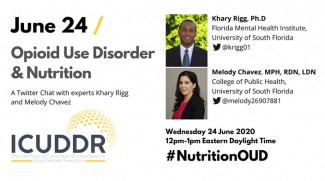
ICUDDR invites you to join this twitter chat on Opioid Use Disorder and Nutrition with expert panellists Khary Rigg, Ph.D. and Melody Chavez, MPH, RDN, LDN
New resource on how to help prevent an opioid related death. Learn about an overdose including the symptoms, how to respond, information on naloxone, tips on preventing an overdose, and resources for seeking help. Download and share now.
We are witnessing, arguably, the greatest public health issue of our time. However, that is not to say the public health concerns that were present before the pandemic have disappeared.
Opioidaddiction and opioid-related deaths continue to cause great harm to society.
This article discusses the way these two critical issues are interacting and causing damage to particularly vulnerable groups of people.
The author describes how social determinants- the conditions in which people are born, grow, live, work and age- influence levels of risk and overall wellbeing.
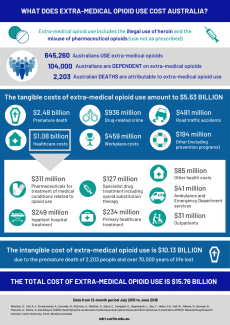
A recent study, published by the National Drug Research Institute (NDRI) at Curtin University in Perth, has estimated that the illegal use of heroin and the misuse of pharmaceutical opioids is costing Australia around $15.7 billion and causing more than 2200 deaths a year.
This is a significant increase from the previous record that was collected in 2007.
Professor Steve Allsop commented:
“Extra-medical use of opioids is likely to result in adverse outcomes that require the use of health services, reduce work productivity, or result in contact with the criminal justice system,”.
Recovery is a process of change through which individuals improve their health and wellness, live self-directed lives, and strive to reach their full potential.
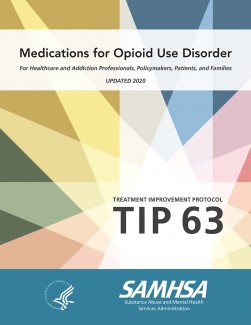
This Treatment Improvement Protocol (TIP) reviews the use of the three Food and Drug Administration (FDA)-approved medications used to treat OUD—methadone, naltrexone, and buprenorphine—and the other strategies and services needed to support recovery for people with OUD.
The coronavirus pandemic has presented a new challenge for public health services around the world.
Although scientists are working tirelessly to comprehend more about the virus, there are still many unanswered questions.
In a recent interview, Dr. Nora Volkow, who heads the National Institute on DrugAbuse, describes factors that may increase the risk of coronavirus causing greater harm to the infected individual.
Naloxon je lék určený k rychlému zvrácení předávkování opioidy. Je to antagonista opioidů – což znamená, že se váže na opioidní receptory a může zvrátit a blokovat účinky jiných opioidů. Může velmi rychle obnovit normální dýchání osobě, jejíž dýchání se zpomalilo nebo zastavilo v důsledku předávkování heroinem nebo opioidními léky proti bolesti na předpis.
Delroy CS, Ifeanyichukwu AO, Rachel BA (2020) Attitudes towards Cough Syrup Abuse: A Study of Adolescents in Southwest, Nigeria. J Addict Behav Ther Rehabil 9:188. doi: 10.37532/jabtr.2020.9(1).188
One area of substance misuse among adolescents that is currently a problem, and has not been fully understood in the Nigerian context is the attitudes of adolescents towards cough syrup abuse. Thus, to inform policy actions for reducing cough syrup abuse among Nigerian adolescents, this study explored the attitudes of adolescents towards cough syrup abuse in two Southwest states of Nigeria, where substance abuse is rampant.
By a stratified sampling method, 302 adolescents (152 males, 150 females; mean age = 13.61 years, SD = 2.09) were selected from secondary schools in Lagos and Oyo states...
As the COVID-19 global crisis continues, it is vital that OpioidTreatment Programs (OTPs) remain stable sources of treatment for patients receiving support for opioid use disorders.
The American Association for the Treatment of Opioid Dependence (AAOTD) has written guidance designed to support opioid treatment services through the COVID-19 crisis.
The guidelines cover:
Maintaining Adequate Supplies of Medications and Other Vital Materials
Abstrakt | Porucha užívání opiátů (OUD) je chronická recidivující porucha, která je zpočátku řízena aktivací neuroobvodů mozkové odměny, ale stále více zapojuje neuroobvody proti odměně, které řídí nepříznivé emocionální stavy a relaps. Úspěšné zotavení je však možné s vhodnou léčbou, i když s přetrvávajícím sklonem k relapsu. Zátěž OUD pro jednotlivce a veřejné zdraví je obrovská; Odhaduje se, že v roce 2016 žilo na celém světě 26,8 milionu lidí s OUD, přičemž >100 000 úmrtí na předávkování opioidy ročně, včetně >47 000 v USA v roce 2017. Dobře provedené studie prokázaly, že dlouhodobá léčba...
Nalliah, R. P., Sloss, K. R., & Kenney, B. C. (2020). Association of opioid use with pain and satisfaction after dental extraction. JAMA Network Open, 3(3). doi:10.1001/jamanetworkopen.2020.0901
Opioid prescriptions increased by 68% from 2010 to 2016 for new dental procedures among people not previously prescribed opioids. This study sheds light on the potential of unnecessary prescribing of opioids for dental procedures especially for people never prescribed opioids prior to their procedure. Those who were prescribed opioids after a dental extraction reported worse pain including more moderate and severe pain than those not prescribed opioids, while both groups reported similar satisfaction levels. Out of 195 extractions, 1145 excess prescription pills prescribed. These findings...