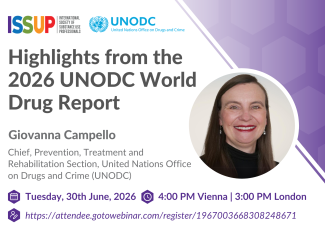
Join our upcoming webinar highlighting key findings from the 2026 edition of the UNODC World Drug Report. The session will be presented by Giovanna Campello, Chief of the Prevention,
Treatment
and
Rehabilitation
Section at the United Nations Office on Drugs and Crime (UNODC).
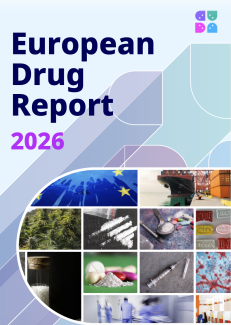
European Union Drugs Agency (2026), European Drug Report 2026: Trends and Developments, https://www.euda.europa.eu/publications/european-drug-report/2026_en
The European Drug Report 2026: Trends and Developments provides the latest overview of the drug situation across Europe, drawing on data from EU Member States, Türkiye, and Norway. The report examines patterns of drug use, drug-related harms, drug supply,
treatment
services, and other interventions, offering a comprehensive picture of developments up to the end of 2025.
Using data collected through national monitoring systems and European research networks, the report highlights emerging trends and supports evidence-informed responses to drug-related challenges. It also emphasises the...
This report highlights a growing concern around stimulant use and related harms in Canada, particularly involving cocaine and methamphetamine. Data from multiple national sources show that stimulant-related deaths have significantly increased, with the rate of toxicity deaths doubling between 2018 and 2024.
At the same time, stimulants are increasingly involved in opioid-related deaths, indicating a rise in
polysubstance use
across most provinces and territories. The health impacts of stimulant use differ from opioids, with the main risks linked to cardiovascular complications, while opioids...
The Canadian Centre on Substance Use and
Addiction
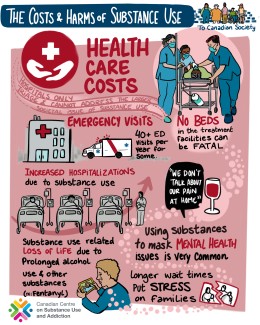
(CCSA) transforms complex data into insights that reflect real human experiences. Every aspect of the Canadian Substance Use Cost and Harms (CSUCH) project represents individuals with lived or living experience of substance use, along with their families, workplaces, and communities.
A new resource highlights these journeys and the human cost of substance use through illustrated stories from people with
lived experience
and their families. The illustrations cover three key areas of the CSUCH project: healthcare, lost productivity, and...
Shamim, U., & Collins, A. (2024). The Impact of Drug
Addiction
on Afghan Refugees in Pakistan: A Comprehensive Analysis. Adiktologie, 24(3), pp–pp. https://doi.org/10.35198/01-2024-004-0001
Drug addiction and its associated consequences, such as long-term dependence, bloodborne illnesses, HIV, sexually transmitted diseases, social isolation, and criminal activity, are gradually being recognised as serious issues that need to be addressed, especially among displaced populations. Due to disputes and conflict in their country, around 1.44 million Afghan refugees (both registered and unregistered) are currently residing in Pakistan in a situation of protracted displacement and significant uncertainty, even though around 4 million Afghan refugees have been repatriated back to...
ISSUP Global, UNODC, and the African Union presents their webinar on the World Drug Report 2025, focusing on key trends and policy challenges for Africa.
Recovery
is not a one-size-fits-all process—it is dynamic, multifaceted, and deeply individual. To truly support individuals on their recovery journey, practitioners must access tools, systems, and knowledge that reflect the realities of those they serve.
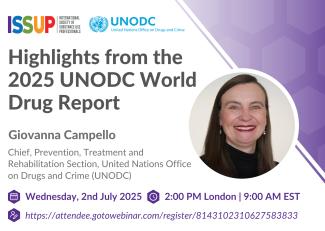
ISSUP in collaboration with UNODC present a webinar highlighting key findings from the 2025 edition of the UNODC World Drug Report. The session is presented by Giovanna Campello, Chief of the Prevention,
Treatment
and
Rehabilitation
Section at the United Nations Office on Drugs and Crime (UNODC).
Join our upcoming webinar highlighting key findings from the 2025 edition of the UNODC World Drug Report. The session will be presented by Giovanna Campello, Chief of the Prevention,
Treatment
and
Rehabilitation
Section at the United Nations Office on Drugs and Crime (UNODC).
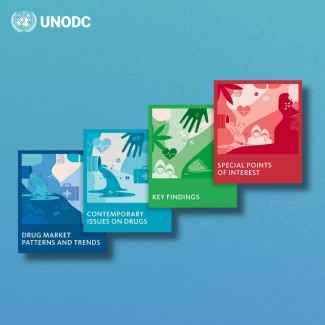
A global reference on drug markets, trends and policy developments, the World Drug Report offers a wealth of data and analysis and in 2025 comprises several elements tailored to different audiences.
Kalicum, J., Nyx, E., Kennedy, M.C. et al. Perceived impacts of North Americas first de-medicalized safer supply program. Subst Abuse Treat Prev Policy 20, 11 (2025). https://doi.org/10.1186/s13011-025-00642-0
Background
A non-medicalized safer supply model called a “Compassion Club” has recently been evaluated. The model involved providing rigorously tested and accurately labeled illicit substances to members at cost. Operating for 14 months in Vancouver's Downtown Eastside, the initiative aimed to explore the effects and feasibility of this approach among individuals at risk of fatal overdose.
Methods
At the one-year mark, 43 club members completed a survey for this cross-sectional analysis. Descriptive statistics were used to assess the perceived impact of membership on factors like drug use...
Addiction
and obesity share similar neurological pathways, both linked to compulsive behaviors and the brain's reward system. Research has highlighted the potential of GLP-1 receptor agonists, originally developed for diabetes, to help manage both appetite and
addictive
cravings. These medications, such as semaglutide, may regulate addictive behaviors by influencing reward circuits in the brain. However, they come with potential side effects, and their long-term effects are still under investigation.
In addition, a new compound, 5-Methoxy-2-aminoindane (MEAI), is being researched for its...
Europol (2025), European Union Serious and Organised Crime Threat Assessment - The changing DNA of serious and organised crime, Publications Office of the European Union, Luxembourg
The EU-SOCTA offers one of the most thorough analyses conducted on the threats posed by serious organised crime to the EU’s internal security. Based on intelligence from EU Member States and international law enforcement partners, this report not only analyses the state of organised crime today – it anticipates threats of tomorrow, providing a roadmap for Europe’s law enforcement...
A global reference on drug markets, trends and policy developments, the World Drug Report offers a wealth of data and analysis and in 2024 comprises several elements tailored to different audiences.
Visually presents substance use trends and describes whether expected substance use aligned with actual substance contents. Data were collected from
harm reduction
sites in seven regions across Canada that participated in the Community Urinalysis and Self-Report Project between 2021 and 2023.
Drugs from the unregulated market often contain added substances that people who use drugs do not know are there or do not intend to use. This is a key driver of unintentional drug poisoning and the drug poisoning crisis.
SAMHSA report discusses the evidence supporting the effectiveness of screening, brief intervention, and referral to
treatment
(SBIRT) as a comprehensive approach, as well as for the implementation and effectiveness of the individual components of SBIRT for different behavioural health conditions.
The report describes briefly the underlying research that has been conducted in the prevention and early intervention of risky alcohol,
substance abuse
and tobacco consumption, as well as commonly reported mental health problems, and describes existing studies/models for specific populations and...
The ASSIST package, which consists of a brief questionnaire, a guide for health professionals on how to use the questionnaire in detecting and responding to substance use and also a self-help manual for cutting down or stopping substance use, is the result of more than 10-years work by WHO and an international group of researchers in the framework of the WHO ASSIST project. It is WHO’s response to the growing demand for guidance on how to best manage problems of substance use in non specialist health care settings. This approach, quick and easy to learn, useful for all substances including...
The DIMS annual report 2022 covers the concentrations, adulterations, and other relevant information produced by DIMS in the past year, and in doing so forms a topical image of the Dutch drug market. Spread out over all Dutch provinces, the DIMS network encompasses 32 testing-facilities providing nation-wide coverage. Together with these partners, DIMS aims to create a clear insight into the Dutch drug market, and signal potential health risks to the public.