Prevention Unpacked with Dr. Zili Sloboda: The Journey and Vision Pt.1
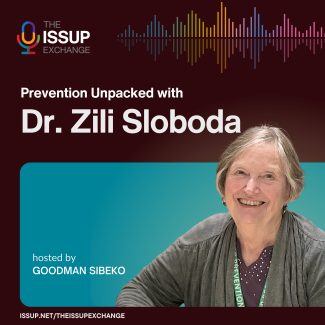
In this first episode of Prevention Unpacked, Associate Professor Goodman Sibeko speaks with Dr. Zili Sloboda about the early experiences that shaped her life and career. The conversation traces her childhood in New York, her exposure to international culture, and the personal influences that sparked her interest in people, behaviour, and social systems.
Dr. Sloboda reflects on her academic path through sociology, public health, and epidemiology, sharing how her early work in medical settings and substance use research shaped her thinking about prevention. She describes the mentors, moments, and turning points that guided her toward a lifelong commitment to understanding behaviour and preventing harm before it begins.
This opening episode traces the origins of a career that would later shape prevention science, beginning not with research, but with curiosity, people, and a lifelong interest in how lives unfold.
Featured Voices
Host – A/Prof. Goodman Sibeko
ISSUP Global Scientific Advisor.
Head of Addiction Psychiatry, University of Cape Town.
LinkedIn: goodmansibeko
Twitter/X: @profgsibeko
Guest – Dr Zili Sloboda
Dr Zili Sloboda is a global leader in prevention science whose work has shaped evidence-based prevention practice worldwide.
Time Stamps
Professor Goodman Sibeko (00:00)
Hello and welcome to Prevention Unpacked, the journey and vision of Zili Sloboda, a special ISSUP podcast series exploring the story behind one of prevention science's most influential voices. I'm Goodman Sibeko the ISSUP Global Scientific Advisor and your host. You can find me on LinkedIn and on the socials at the handle of Prof. G. Sibeko. And you can find ISSUP on LinkedIn, X, Blue Sky. Just type ISSUP and you'll find us easily.
Dr. Zili Sloboda is an internationally respected leader whose work has defined the field of prevention science. After early academic roles at Johns Hopkins and leadership at the National Institute on Drug Abuse.
She founded Applied Prevention Science International, dedicated to training and supporting prevention professionals globally. Her research has really shaped evidence-based prevention approaches and her leadership in initiatives like Universal Prevention Curriculum and Society for Prevention Research has built the foundation for today's global prevention movement. With decades of contributions spanning research, policy and capacity building, Dr. Sloboda continues to champion the integration of science and practice to create healthier, more resilient communities worldwide.
In this first episode, we step back to the beginning to trace the roots of Dr. Sloboda's remarkable career. We'll hear about her early influences, the academic path that shaped her, and the pivotal moments that drew her towards a lifelong commitment to substance use prevention. It's a story of curiosity, resilience, and discovery, and one that offers a deeply personal window into how a global field was born. Zili, it's an absolute honour and a pleasure to have you join us. Perhaps to get us started, could you share with us a bit about your early life, where you grew up, how your environment or family influenced your later interests?
Dr Zili Sloboda (01:57)
Yes, thank you very much, Goodman. It's a pleasure to be here today with you and with our audience. I've had a long career. I think this question was very helpful for me to think back on what the influences were for my very crooked path to where we are today. My first 14 years were spent in New York City.
And I believe those years influenced my life course. Being in New York among people from all over the world, speaking different languages, eating different foods, but also in the early years, the United Nations was started in Lake Success, near where I was living. And my parents, who are both from Europe originally, were very excited about the creation of the United Nations and often took my brother and myself there to visit. That really impacted me as a child. I wanted to work at the UN when I grew up and tried over the years to get a job there. But when I was close, when I was getting my doctorate, I was told that the UN wasn't hiring Americans at that moment. So I was very disappointed. So it wasn't until 2012 that I finally actually had a contract in my hands working with Giovanna Campello and her staff on the International Standards for Drug Use Prevention. So the message to the audience is, if you live long enough, your childhood dreams may actually come true. But you can see I had a keen interest in working internationally early on.
Professor Goodman Sibeko (03:30)
That's incredible. And of course, Giovanna is a very good friend of ISSUP. And so we appreciate that tie in. And what you've mentioned, the influence of the languages, exposure to culture and having this lifelong dream. Are there particular experiences or people that you would say sparked your curiosity even further about human behaviour, health or social systems?
Dr Zili Sloboda (03:52)
Okay, I will share the secret with you and the audience. I was always a people watcher and interested in working with people to help improve lives. My first job out of college was a research assistant as an evaluation study of a geriatrics clinic that was housed in New York City Housing Project.
That was where a lot of elderly people were living at the time. Most of them had come from other countries and had come to the United States either before or after World War II. So my job was to interview them about their health, but I also enjoyed talking to them about their lives before coming to the United States and then how they adjusted to their new lives in the United States, new culture. Probably I was more sensitive and aware to their transitions as I mentioned before, my parents and grandparents were from Europe and came to the United States in the early 1900s.
Professor Goodman Sibeko (04:48)
It's incredible how listening to people, especially with a life of experience, really starts to shape how you think and how you perceive life and what you perceive as being important or not to what your priorities are. So in your view, what values or ideas either linked or shaped by or already present within you shaped your approach to work and learning early on.
Dr Zili Sloboda (05:11)
I think openness and listening, I think were a key concept from this early work that I think have really influenced me over my career and also impacted my personal life. Friendships, I think it's important to have an openness to other cultures, other views, other ways, other languages.
Words have such meaning as you know, Goodman, and to be really cognizant of that.
Professor Goodman Sibeko (05:35)
That really shapes the components of the work we do in substance use treatment, isn't it? We really strive to make sure that we're responsive to the needs and the context of the people that we try to serve and work with. In terms of, you know, your academic and professional start, so it's great to hear how that started to shape how you think. What specifically in your journey drew you into sociology and public health at first?
Dr Zili Sloboda (06:02)
Given the background that I just mentioned about my childhood, I think you can understand how my experiences drew me to sociology and then ultimately to public health. I started out thinking about social work, but during the summer between my junior and senior year of college, I began reading the American Journal of Sociology and decided that research could enable me to reach and impact the lives of more people than social work. And I don't think I was really that good as a social worker. Then later on, because of my work at the geriatrics clinic, I decided I wanted to go into medical sociology. And it was after college that I began working at the clinic. I went to graduate school at night. So I had that combination of working during the day and having that experience listening to people, specifically around their health issues, these older people and then the academics at night It really connected, connected for me. So, after that project, I worked as a research associate for the New York City Narcotics Register. That was the introduction I had to the field of substance use. I enjoyed that a lot because I had an opportunity to really understand behaviour, this kind of behaviour, in working with people with histories and having a better understanding of why. I guess that's where it started my interest in prevention of how people got involved with substance use. Then there were many people I worked with in substance use treatment programs that really were just wonderful colleagues introducing me to my life.
But I was also fortunate enough to work with some really great professionals who were important names in the field. One was Michael Baden who was the Associate Medical Examiner at the time. I did some work with him on mortality amongst narcotic users. I had the opportunity to work with Vincent Doll and Marie Nyswander who were studying the outcomes from methadone maintenance, as well as George De Leon who was studying the impact of therapeutic communities. It was an extremely exciting time and place for substance use epidemiology and treatment.
Professor Goodman Sibeko (08:11)
So it sounds to me, it's really about your own orientation towards learning and your own orientation towards being people centered and also picking up on all the things that interest you that seem to feed into that. And of course, leaning into these folks you've mentioned who have influenced your thinking about prevention and research, your mentors. So to tie that all together, you know, we talk about the need and we'll talk about it in the episodes that follow for prevention professionals to have appropriate training. So training is still integral to tie in all of these components. How did your early training at Johns Hopkins and your work at NIDA shape your scientific lens?
Dr Zili Sloboda (08:51)
Wow. Let me just introduce this by an evaluation I had by a former supervisor who called my work Byzantine. Okay. And then, you know, after you get your written evaluation, you are supposed to come back and discuss it with your supervisor, right?
So I thought, wow, he really got me, Byzantine, because to me, I think of Byzantine as being different tiles and different shapes and sizes and things fitting together, right? So when I went the next day to review my evaluation, I thanked him for recognizing that. And he said to me, “It wasn't flattering. But now that you mentioned it, yes, you do that”.
There were so many people who influenced me at that time. As I said, I had so many different experiences. At one point, I didn't mention this earlier, I had a year in Louisville, Kentucky, and I worked at the Louisville General Hospital as a medical social worker, because I couldn't get a job as a researcher.
It was right after the hospital was desegregated. And here I was a little New York girl coming into the South and that was a really interesting experience. In so many ways as you can well imagine, but actually in a hospital was very important. I think the experience gave me more insights into medical behaviour, health behaviour, and meeting people from who had to be approached differently. That was really, I think, very influential.
Obviously, my work at Hopkins was influential because I was working full time on a research project while working towards my doctorate. I was doing an assessment of a civil commitment program for narcotic addicts. And of course, that gave me a wonderful experience. I even taught some classes. And so all that influenced me a great deal.
It was very interesting because before I went to NIDA, I moved to the Philadelphia area and I was working in cancer prevention. And we were noticing people coming in with Kaposi sarcoma. And that got me interested in HIV and the relationship with HIV and substance use. And there were very few people doing epidemiological work at that time.
By the way, my degree at Hopkins was in epidemiology and mental health. So that's my interest in epidemiology. And that brought me to the National Institute on Drug Abuse because the National Institute Drug Abuse was starting a research program on HIV epidemiology and prevention. And I was part of a small team that were developing that whole area. So here I was coming into to the national level, which was really exciting, something really new, which opened so many opportunities. But the whole idea of prevention then really took off, really came forefront to me, prevention of HIV an easy transition to prevention of substance use. I was always interested in prevention of substance abuse, but it became an easy transition then to becoming the chief of the prevention research branch, and then ultimately the division director for epidemiology and prevention research. So you can see how everything sort of built to that level. So that's where I am.
The reason why I started Applied Prevention Science International was that I was frustrated when I was at National Institute on Drug Abuse as to how to get this research to the practice community. And I think it's not so bad now, but at that time there was more friction or misunderstanding between practice and research in those days. And so it was kind of frustrating. So when I left and did the work with Giovanna at the UNODC, I saw this opportunity too.
It was really weird because you would think training would be a natural, right? You think that would be a natural way to go. It didn't even enter my mind until I was working on the international standards. And I literally had that “aha moment”. Like you can almost feel the light bulb go off in my head, that training was the answer. And I knew that the U.S. State Department was developing the Universal Treatment Curriculum.
And so I approached them because when I was at NIDA, we did a lot of international stuff with the Department of State. And I approached Thom Browne at the Department of State about this. And he said, “Is there enough there?” And I said, yeah, there's a lot there. I think we can do this. And that's how we started to develop the UNIVERSAL PREVENTION CURRICULUM.
Professor Goodman Sibeko (13:47)
That's such a wonderful story, Zili. It's great to see. And I think, you know, for a lot of us, we end up working in this space. We start in one area, and then we realise the interrelationship, we realise that actually, when we're trying to prevent one thing, it easily translates to, well, how do we address the other factors that impact what comes for this population?
So it's great to see that transition into more the substance use prevention, which was actually going to be my next question, but you've answered it already. And also importantly, that translation element really of then saying, okay, we've done all this research, we have all this evidence. What do we do with this to make sure that the practice community knows what to do? And then that training gap. that's a really great follow through story there, Zili. And so I think you've also highlighted how these projects and how the areas of focus that were prevailing at the time, sort of really solidified your commitment to the field and have led to some of the work that you've done. When you started, how did the prevention field really look? And in your mind, what was the dominant paradigm or main challenge at the time?
Dr Zili Sloboda (14:54)
Well...I think, really early on, it was pretty primitive. And a lot of the work was basically information dissemination, giving kids information about the impact of substance use. You're more on the negative side. In my mind, I think what was really key, and those who've taken the Universal Prevention Curriculum know this what really was pivotal were the longitudinal studies that were supported by the National Institute on Drug Abuse. And these, of course, were from the 70s and 80s, where young people were followed over time. We had a number of those studies that went on. We were able to then really get a better idea of there's no one single pathway to any negative behaviour like substance use. The whole period of development is so important and all the influences on us as human beings in our own families and cultures that are important for us to be completely socialised into our societies. And sometimes these things don't always help us to make that process easy. Sometimes it's very challenging, whether it's our families, whether it's the political environment, whether it's now, of course, it's extreme weather events.
So, you know, I mean, that I think we gained, we learned a lot from those studies. The field attracted a lot of research, researchers, right, from a variety of just different disciplines. I think that's the other thing that makes substance use different from a lot of the other areas certainly that I've been involved in, is the richness that professionals bring to the field that it's so many, because of all these many influences on individual behaviour. So we have psychology, we have sociology, anthropology has contributed a great deal to the field. Public health, I think, and also the fields of epidemiology have really helped define what's associated with this behaviour.
I think those are the things that really have made the field richer and have helped us develop evidence-based interventions. The other part of that, of course, is methodology and statistical methodology. And I remember when I was at NIDA, there was a meeting, an in-house meeting. We were invited a prevention researcher in to present her data. And there was a lot of criticism of the work because, you know, prevention, you're not getting 100 % change, but you don't do that for treatment either, by the way. And how do you measure something that doesn't happen, right? So I think our statistical methodologists and our research design people in our field have been creative in helping to really bring science and to create prevention science. And of course the term prevention science we coined in 1991. When we started the Society of Prevention Research, it was really going be the Society of Prevention Science, but that wasn't too well received. And so we made it in Society of Prevention Research. In a way, I think that's a good thing because we were also able to bring in more practitioners.
We wouldn't have probably done it if it was science. But I really think that, that the defining prevention science didn't happen until, well, actually the Society of Prevention Research when we did the Standards of Knowledge in 2008 to 2011, sort of defined it. The Society of Prevention Research has updated all of that. It's coming out next year. So we've been refining and refining and refining these terms.
So, but there is more international recognition that there is a science of prevention. And for me, like chemistry or medicine, I think it's important that there's international embrace of prevention science as a science.
Professor Goodman Sibeko (19:10)
You know, I think it's funny you say that. I mean, a lot of people still need some convincing, but information giving is not enough. And I think that's part of the journey is saying it has to be part of a comprehensive strategy, hasn't it? And that the folks involved really have to be capacitated and given the structural support to make sure that they are delivering evidence-based strategies. So it's really great that you've brought in the richness that the, you know, intersectional work means for prevention science in general and also really anchoring it in the importance of methodology and specifically statistical methodology. I would imagine that at the beginning, wasn't quite so easy, you know, before prevention was recognised as a science, what resistance or misconceptions would you say you faced in your early years?
Dr Zili Sloboda (19:56)
Well, it didn't help that I was probably one of the few women in the field. That's changed a lot. Now I go to the meetings, Society for Prevention Research in the United States and in Europe. I'm so thrilled to see so many women have come into the field.
It's a difficult question to answer, actually, I think.
It really is a process. With most new things, having key individuals who step forward and say, this is the way to go, I think that's helped a lot. As I said, measurement was a big problem. I have found in the beginning when we were talking about evidence-based programs,
Sometimes when I would be talking to practitioner groups, half of the group would get up and walk out of the room because of that, I mentioned the friction before. I think that's changed a lot. Thank goodness. That's changed worldwide, to be honest with you, it's a thrill to see that every time I go to a meeting. I wish more practitioners were going to the Society for Prevention Research meetings. When we conceived of ISSUP we thought of it as being an opportunity for practitioners to meet researchers from all over the world. I've always felt that this was important in the United States, but I think this worldwide too. There's a lot of friction between treatment practitioners and prevention practitioners. I understand it, but I don't think that helps us, helps the field and certainly doesn't help people who are impacted by substance use. And I'm still trying to get treatment and prevention people to work together because if we can address some of the reasons why people started to use substance use in the treatment process we can impact outcomes.
It would really be helpful, I think. But yes, ISSUP was an opportunity for prevention practitioners and treatment practitioners to talk to each other, to get to know each other. I was hoping a little side groups would say, “I'd like to do this. What do you think?” So I think we've come a long way to bridge those gaps. I think one of the big challenges today is harm reduction. It has been for years. It has an important role in the work we do both in prevention and treatment. Maybe we have to get a different name to it. But I think that's another area that we really need to work on. It's really important.
Professor Goodman Sibeko (22:22)
That's great. I think you've already spoken about, you know, working with different disciplines. I'm quite curious. Initially, just very briefly, how would you say, how would you describe how you've navigated working across disciplines, you know, with different areas of focus, different ways of working in sort of driving the field of prevention science? How have you navigated that?
Dr Zili Sloboda (22:47)
I think it goes back to one of your earlier questions was listening, it's being open to people, different ideas. One of my favourite things when I was at the National Institute of Drug Abuse, and still at Applied Prevention Science International, is getting staff together around a topic area. And the noisier the room is, the better. Different ideas, people presenting their cases. I think when we talk to each other, we all learn.
Yes, as I said, even when we're not very nice to each other, I think we learn from each other. And I think we need to give opportunities for that kind of discussion. I think that's really important. I think that's how we make progress is, yes, we achieve a lot through the work that we do, but we need to step back and look at what it is that we're doing, not one person or one field knows all the answers. I don't think we do enough qualitative research. We don't have enough anthropologists, for instance, working with us. In epidemiology, it was the anthropologists who were the first epidemiologists in our field. Look at all that we learned. Look at what we learned during HIV to inform prevention programming. So I think the more arguments and more discussions we have across disciplines, the more we're going to learn.
Professor Goodman Sibeko (24:07)
So listen, but be willing to engage, willing to hear an idea that hasn't necessarily previously resonated with you, but be willing to listen to the evidence and reappraise your own position. finally, Zili, you've already spoken about how important it is in order to establish a new field and yourself in the space about following process about understanding who the key individuals are and about ensuring that you're measuring what you're doing. Are there any other early lessons that you would say have stayed with you about building credibility and impact in a new field?
Dr Zili Sloboda (24:43)
That's a really challenging question. Staying with it. Also, I sort of touched on this. My pathway has been really, really crazy. There was no direct path. And I tell young people today, okay, if you get deviated from the path that you thought you had set before you, take advantage of this new opportunity, this deviant path that you didn't think you were, oh, I don't want to take that job. I don't want to do that work.
You will find that you are going to learn from that experience. And you also bring to that experience all your efforts from prior work. And you'll be bringing that and it becomes more, not unidimensional, it becomes multidimensional. And I think each pathway that I’ve taken, sometimes I've been disappointed. First, as I mentioned that I would, I wanted to do research and then I went to Louisville. I was doing medical social work. Wow. I mean, if I had kept blinders on, I would not have learned about health behaviour and how people respond to being in an environment and also that medical, the interaction between the patient and the medical staff. It was really fascinating to see. I learned a lot from that. Plus I can diagnose almost....
No, I'm only joking. But it was a wonderful experience. But if I had had blinders on, it wouldn't have been. I brought a lot of that experience into my work afterwards. So I think, you know, that's my comment to young people is yes, we don't always follow the same path, the path that we set out before us. And I sound like a broken record. I'm sure other people said the same thing before me. But when you get older, you begin to see that these twisting, turnings, you always come out, you can always come out ahead and then you begin setting your own path.
Professor Goodman Sibeko (26:38)
Zili, what a fantastic note to end this episode on. Thank you so much. Really appreciate you taking the time to join us for this first session.
Dr Zili Sloboda (26:45)
It was a pleasure. Thank you so much.
Professor Goodman Sibeko (26:47)
Thank you everyone for joining us for this first conversation in Prevention Unpacked. Dr. Sloboda's reflections remind us that prevention is not just a discipline, it's a calling rooted in values, relationships, persistent opportunity. In our next episode, we'll move from the personal to the scientific, tracing how prevention has evolved from just an idea to a global evidence-based field and how Dr. Sloboda has helped shape that transformation. Stay tuned and keep exploring prevention with us.
Thank you for spending this time with us. We hope you enjoy that as much as we do. Be sure to hop on over to our website, isop.net, where you'll find information on how to sign up for free membership. Take care and catch you on the next one.
About the ISSUP Exchange
The ISSUP Exchange podcast series explores the evolution of responses to the challenges of substance use—from research and training to ethics, quality standards and evidence-based practice. We connect the dots so you can see the big picture.
Explore more episodes and join the ISSUP podcast community here>>>
About ISSUP
ISSUP is a global network that unites, connects, and shares knowledge across the substance use prevention, treatment, and recovery support workforce. Our mission is to make our members’ work as effective as possible—by providing access to training, resources, and a vibrant professional community.