All Resources for 'Community-Based Recovery and Treatment'

Law Enforcement Pre-Arrest Diversion Resource Guide

Format
Guide
Themes
Treatment
Ancillary Services
Recovery Support
Peer and Community Support
Quality Assurance
Best Practice Guidelines
Monitoring and Evaluation
Professional Development
Law Enforcement
Police 
Responding to Drug-Related Offending 
Health & Justice Responses 
Justice and Diversion

The Law Enforcement Pre-Arrest Diversion Resource Guide, developed by SAFE Project in collaboration with the Police, Treatment, and Community Collaborative (PTACC), provides practical guidance on alternatives to arrest for individuals...

Youth Recovery: Supporting Adolescents and Young Adults – Reading List 

Format
Reading List
Themes
Prevention
Community-Based
Family-Based
School-Based
Treatment
Behavioural Therapy Interventions
Treatment Settings
Recovery Support
Peer and Community Support
Recovery-Oriented Services
Populations
Family
Children, Adolescents & Youth 
Quality Assurance
Best Practice Guidelines
Implementation Science
Public Health
Global Health Perspectives
Mental Health
Resilience and Coping Strategies
Reading List

In this reading list, we provide resources exploring recovery from substance use disorders among adolescents and young adults, with a particular focus on recovery capital, supportive educational environments, and community-based recovery...

Family Intervention Models for Young Adults with Substance Abuse: A Systematic Review

Publication Date
Format
Scientific article
Themes
Prevention
Family-Based
Treatment
Behavioural Therapy Interventions
Populations
Family
Children, Adolescents & Youth 
Quality Assurance
Best Practice Guidelines

Published in the Indian Journal of Psychological Medicine, this systematic review examines the effectiveness of family-based interventions for addressing substance use among adolescents and young adults.

The researchers reviewed 41 studies...

Community support and youth recovery: the mediating role of peer and parental disapproval

Publication Date
Format
Scientific article
Themes
Prevention
Community-Based
Family-Based
Recovery Support
Peer and Community Support
Recovery-Oriented Services
Populations
Family
Children, Adolescents & Youth 
Public Health
Theories and Science

This study, published in Frontiers in Adolescent Medicine, examines the relationship between community recovery support, parental and peer attitudes towards substance use, and recovery among young people.

Using data from the 2022 Illinois...

Participant Experiences of a Collegiate Recovery Program on a UK University Campus

Publication Date
Format
Scientific article
Themes
Recovery Support
Peer and Community Support
Recovery-Oriented Services
Populations
Family
Children, Adolescents & Youth 
Quality Assurance
Implementation Science
Mental Health
Resilience and Coping Strategies

This study, published in Alcoholism Treatment Quarterly, explores the experiences of university students participating in Better Than Well, a university-led Collegiate Recovery Program at the University of Birmingham in the United Kingdom.

...

Non-invasive vagus nerve stimulation for substance use disorder: A narrative review

Publication Date
Format
Scientific article
Themes
Psychoactive Substances
Addiction
Populations
Men
Women
Quality Assurance
Implementation Science

Abstract

Background

Recent technological advances have led to increased experimentation in non-invasively modulating the brain to reduce craving and drug use in substance use disorder (SUD). However, many forms of neuromodulation remain...

Adaptation of the Multidimensional Inventory of Recovery Capital (MIRC) to the Czech Environment

Publication Date
Format
Scientific article
Themes
Treatment
Ancillary Services
Recovery Support
Peer and Community Support
Recovery-Oriented Services
Quality Assurance
Best Practice Guidelines
Monitoring and Evaluation
Public Health
Theories and Science
Partner Organisation

INTRODUCTION: While international attention toward addiction recovery research is growing, in the Czech environment there is still a lack of research data and tools for measuring this concept. The primary objective of the research project...

AddictologyIssue 2/2026

Fear of Missing Out on Social Networking Sites: Associations with Life Satisfaction, Problematic Social Media Use, Depressive Symptoms and Phubbing in Young Adulthood

Publication Date
Format
Scientific article
Themes
Prevention
Media-Based
Psychoactive Substances
Addiction
Populations
Family
Children, Adolescents & Youth 
Public Health
Theories and Science
Partner Organisation

INTRODUCTION: Social networking sites have become an integral part of everyday life. Their use is closely linked to the phenomena of FoMO (fear of missing out), phubbing, depressive symptoms, life satisfaction and problematic social media...

AddictologyIssue 2/2026

Call for Abstracts: Lisbon Addictions

Format
News
Themes
Treatment
Prevention
Prevention
Treatment
Addiction
Populations
Professional Development
Public Health
Theories and Science
Mental Health
Policy

The 2027 edition of Lisbon Addictions will take place from 20–22 October 2027 under the overarching theme ‘Addiction in times of disruption: science, technology and whole-of-society responses’.

Submission of abstracts

Potential...

Psychosocial case management: connecting treatment, relationships and community recovery

Publication Date
Format
Guide
Themes
Prevention
Community-Based
Treatment
Ancillary Services
Behavioural Therapy Interventions
Pharmacological Interventions
Treatment Settings
Recovery Support
Peer and Community Support
Recovery-Oriented Services
Populations
Public Health
Mental Health
Policy
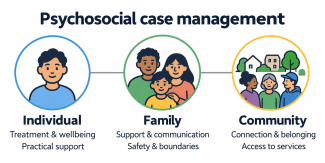
Psychosocial case management connects evidence-based treatment with the practical and relational support needed for sustained recovery. Its clearest benefits are helping people access services and remain engaged in care. Individual care should consider housing, mental health, meaningful activity and continuity of support after discharge. Families and affected communities also need support, with involvement guided by consent, safety and individual circumstances. For treatment and prevention, interventions should address identified needs, draw on relevant evidence and be reviewed as circumstances change.